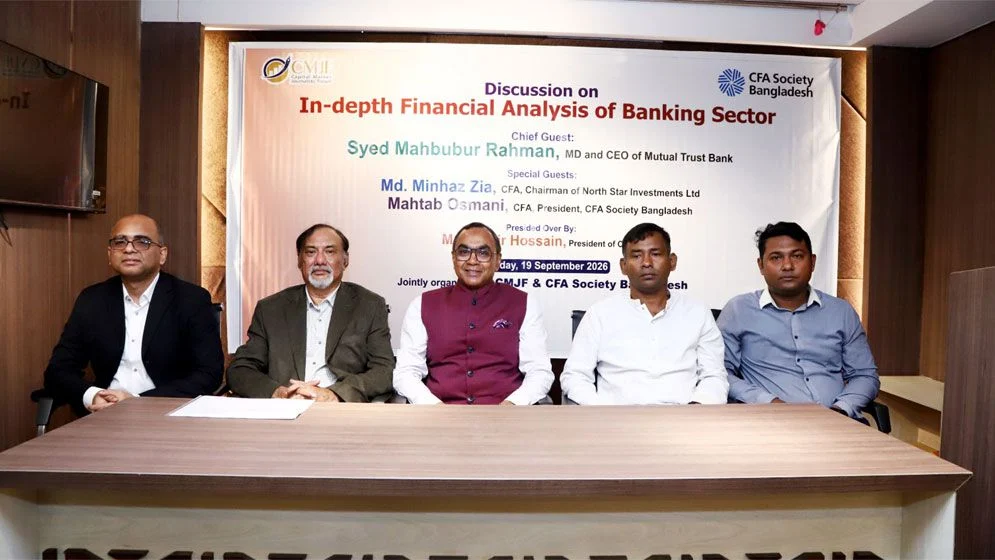
The country's banking sector is currently facing severe crises, marked by capital deficits, liquidity crunches, and massive amounts of non-performing loans (NPLs). Speakers at a seminar emphasized that establishing good governance and implementing legal reforms are imperative to resolve these critical issues.
The seminar, titled "Evaluation of the Financial Condition of the Banking Sector," was jointly organized by the Capital Market Journalists' Forum (CMJF) and CFA Society Bangladesh on Saturday at the Al-Razi Complex in the capital.
Syed Mahbubur Rahman, former Chairman of the Association of Bankers, Bangladesh (ABB) and Managing Director of Mutual Trust Bank, attended the event as the chief guest.
Presided over by CMJF President Md. Monir Hossain, the seminar featured keynote presentations by Sakib Chowdhury, Head of Research at UCB Stock Brokerage, and Iqbal Hossain, CFO of Sonali Bank. Mahtab Uddin Ahmed (Osmani), President of CFA Society Bangladesh, delivered the welcome speech.
Minhaj Zia, Chairman of North Star Investments, graced the event as a special speaker, while the program was conducted by CMJF General Secretary Ahsan Habib Russell.
During the session, speakers noted that several misconceptions persist regarding the country's banking sector.
Syed Mahbubur Rahman stated that maintaining bank stability is impossible by relying solely on interest rates or depositing funds into government securities. Over the past few years, banks have generated profits from foreign exchange and government securities, but their primary function—disbursing loans—has suffered severe setbacks. Net interest income has plummeted, which is alarming for the entire banking sector.
He highlighted that in 2008, total default loans in the country's banking sector stood at around Tk 22,000 crore, whereas today it has surpassed Tk 6 lakh crore. Although official records attempt to show default loans at 15 percent, including loans under policy support pushes the actual figure beyond 32 percent.
He further noted that once the international accounting standard 'IFRS-9' is officially implemented, banks' provisioning obligations will increase significantly.
Answering a question, Syed Mahbubur Rahman said that nearly 75 percent of a bank's expenses are uncontrollable, including rent, employee salaries, and insurance. While long-term efficiency can be improved by leveraging artificial intelligence and new technologies, operational costs cannot be reduced abruptly.
Regarding bank mergers, he opined that a merger makes sense for integrating technology between a strong bank and another institution, but combining multiple weak banks will yield no positive outcome.
Mahtab Uddin Ahmed (Osmani) emphasized the need to explain the financial condition and capital adequacy of the banking sector clearly to the general public. Enhancing financial literacy will enable ordinary investors and depositors to discern accurate information rather than heed rumors.
The keynote paper addressed several common misconceptions about the banking sector. First, regarding investment income versus loan disbursement income, a prevailing notion is that banks earn more by investing in government bonds instead of issuing loans. However, in reality, investment income is calculated on a gross basis, whereas loan income is calculated on a net basis after deducting deposit interest.
Minhaj Zia, Chairman of North Star Investments, pointed out that 80 to 90 percent of total national savings are deposited within the banking sector, while contributions from the capital market or other sectors remain minimal. Consequently, if the banking sector collapses, the entire national economy will come to a standstill.
— Daily Best News Desk • Fearless in the search for truth
Reported by Staff Correspondent • Edited by the Daily Best News desk. Send corrections to [email protected].