60 Percent of Online Financial Fraud Occurs via bKash, Victims Face Lack of Remedy

Staff Reporter, Dhaka
১৪-৯-২০২৬ দুপুর ১২:৪৬
60 Percent of Online Financial Fraud Occurs via bKash, Victims Face Lack of Remedy
With the expansion of digital transactions, new traps for online fraud are emerging, with mobile financial services (MFS) increasingly becoming a primary tool for scammers. According to statistics from the Criminal Investigation Department (CID), a staggering 60 percent of MFS-based frauds occur specifically through bKash accounts, while victims complain of a severe lack of recourse. Furthermore, the platform's accountability and security measures have come under questioning due to its refusal to disclose information regarding accused merchants.
Meanwhile, the Bangladesh Bank recently issued directives to all scheduled banks and MFS institutions in the country to curb online financial fraud, setting a deadline of September 15 for submitting compliance reports.
Analysis of Cyber Police Center complaints, victim statements, and general diaries (GDs) lodged at police stations reveals that criminals are continuously executing sophisticated scams using mobile banking services, particularly leveraging bKash merchant accounts. Although bKash reportedly verifies business credentials such as trade licenses before issuing merchant accounts, victims note that when they approach the company with complaints, action is frequently delayed or avoided under the guise of legal complexities. Furthermore, victims are allegedly denied cooperation in taking action against fraudulent merchant entities used in transactions.
A victim named Abrar Sakif told this correspondent that he lost one lakh Taka after falling into a trap while trying to pay for a passport application fee. Following the incident, he immediately filed a GD at Sher-e-Bangla Nagar Police Station and contacted bKash, but received no assistance or perpetrator details. When he requested the name and address of the merchant involved, bKash authorities stated that it was legally impossible to disclose business entity details.
Abrar remarked, "Instead of convenience, people are now facing more trouble through bKash transactions. How can transactions be completed from another device without entering the password or verification code from my phone's app? There must be some technical loophole in bKash, and their officials' behavior is suspicious. Countless financial frauds happen every day. If such fraudulent activities are not stopped, bKash use must be dropped. Bangladesh Bank should hold bKash accountable for these fraud incidents."
Another victim, Kazi Sakif, stated he was defrauded of 70,000 Taka while ordering a mobile phone online, as money was deducted via bKash before any product delivery. Despite filing a GD and lodging a complaint, bKash took no action, citing restrictions by Bangladesh Bank regarding the disclosure of customer data when asked for the merchant's banking details.
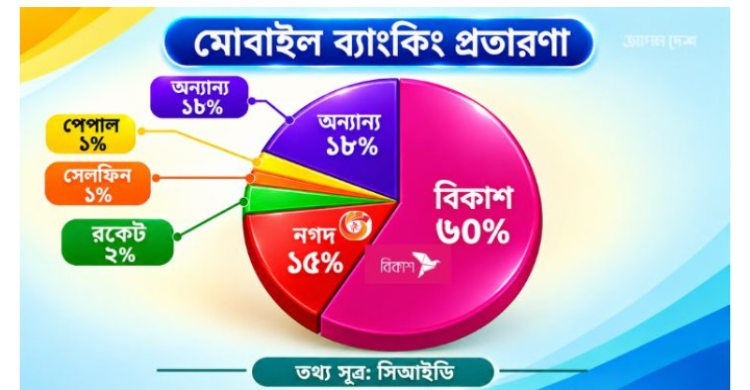
The CID's Cyber Police Center regularly receives various fraud complaints. Between early 2020 and April 30, 2026, a total of 1,80,553 complaints were lodged. Comprehensive CID data covering an 11-month period from June 1, 2025, to April 30, 2026, indicates that 60 percent of mobile banking-related fraud occurred through bKash accounts, followed by 15 percent via Nagad, 2 percent via Rocket, 1 percent via Cellfin, and 18 percent through other channels.
In a recent operation, the DB-Cyber and Special Crime (North) Division of the Dhaka Metropolitan Police arrested a member of an online loan fraud syndicate named Mehedi Hasan from Sarishabari, Jamalpur, on Monday (September 7). The syndicate published attractive digital loan advertisements on Facebook, instructing victims to open accounts on specific websites and demanding 10 percent of the requested loan amount as a prerequisite for approval. Once paid, victims were shown digital loan balances on a website with no actual cash withdrawal capability, with the extorted funds collected via bKash, Nagad, or Rocket.
To combat these scams, Bangladesh Bank recently instructed all scheduled banks and MFS providers to detail various fraud mechanisms, evaluate settlement frameworks under existing laws, and outline active measures taken against crimes along with public awareness initiatives, requiring a report submission by September 15.
When contacted, Shamsuddin Haidar Dalim, Head of Corporate Communications at bKash, told the media that information regarding the exact number of fraud incidents involving bKash or the actions taken cannot be disclosed due to specific regulatory restrictions by Bangladesh Bank. He offered the same response regarding customer complaint resolutions.
Staff Reporter, Dhaka
১৪-৯-২০২৬ দুপুর ১২:৪৬
With the expansion of digital transactions, new traps for online fraud are emerging, with mobile financial services (MFS) increasingly becoming a primary tool for scammers. According to statistics from the Criminal Investigation Department (CID), a staggering 60 percent of MFS-based frauds occur specifically through bKash accounts, while victims complain of a severe lack of recourse. Furthermore, the platform's accountability and security measures have come under questioning due to its refusal to disclose information regarding accused merchants.
Meanwhile, the Bangladesh Bank recently issued directives to all scheduled banks and MFS institutions in the country to curb online financial fraud, setting a deadline of September 15 for submitting compliance reports.
Analysis of Cyber Police Center complaints, victim statements, and general diaries (GDs) lodged at police stations reveals that criminals are continuously executing sophisticated scams using mobile banking services, particularly leveraging bKash merchant accounts. Although bKash reportedly verifies business credentials such as trade licenses before issuing merchant accounts, victims note that when they approach the company with complaints, action is frequently delayed or avoided under the guise of legal complexities. Furthermore, victims are allegedly denied cooperation in taking action against fraudulent merchant entities used in transactions.
A victim named Abrar Sakif told this correspondent that he lost one lakh Taka after falling into a trap while trying to pay for a passport application fee. Following the incident, he immediately filed a GD at Sher-e-Bangla Nagar Police Station and contacted bKash, but received no assistance or perpetrator details. When he requested the name and address of the merchant involved, bKash authorities stated that it was legally impossible to disclose business entity details.
Abrar remarked, "Instead of convenience, people are now facing more trouble through bKash transactions. How can transactions be completed from another device without entering the password or verification code from my phone's app? There must be some technical loophole in bKash, and their officials' behavior is suspicious. Countless financial frauds happen every day. If such fraudulent activities are not stopped, bKash use must be dropped. Bangladesh Bank should hold bKash accountable for these fraud incidents."
Another victim, Kazi Sakif, stated he was defrauded of 70,000 Taka while ordering a mobile phone online, as money was deducted via bKash before any product delivery. Despite filing a GD and lodging a complaint, bKash took no action, citing restrictions by Bangladesh Bank regarding the disclosure of customer data when asked for the merchant's banking details.
The CID's Cyber Police Center regularly receives various fraud complaints. Between early 2020 and April 30, 2026, a total of 1,80,553 complaints were lodged. Comprehensive CID data covering an 11-month period from June 1, 2025, to April 30, 2026, indicates that 60 percent of mobile banking-related fraud occurred through bKash accounts, followed by 15 percent via Nagad, 2 percent via Rocket, 1 percent via Cellfin, and 18 percent through other channels.
In a recent operation, the DB-Cyber and Special Crime (North) Division of the Dhaka Metropolitan Police arrested a member of an online loan fraud syndicate named Mehedi Hasan from Sarishabari, Jamalpur, on Monday (September 7). The syndicate published attractive digital loan advertisements on Facebook, instructing victims to open accounts on specific websites and demanding 10 percent of the requested loan amount as a prerequisite for approval. Once paid, victims were shown digital loan balances on a website with no actual cash withdrawal capability, with the extorted funds collected via bKash, Nagad, or Rocket.
To combat these scams, Bangladesh Bank recently instructed all scheduled banks and MFS providers to detail various fraud mechanisms, evaluate settlement frameworks under existing laws, and outline active measures taken against crimes along with public awareness initiatives, requiring a report submission by September 15.
When contacted, Shamsuddin Haidar Dalim, Head of Corporate Communications at bKash, told the media that information regarding the exact number of fraud incidents involving bKash or the actions taken cannot be disclosed due to specific regulatory restrictions by Bangladesh Bank. He offered the same response regarding customer complaint resolutions.