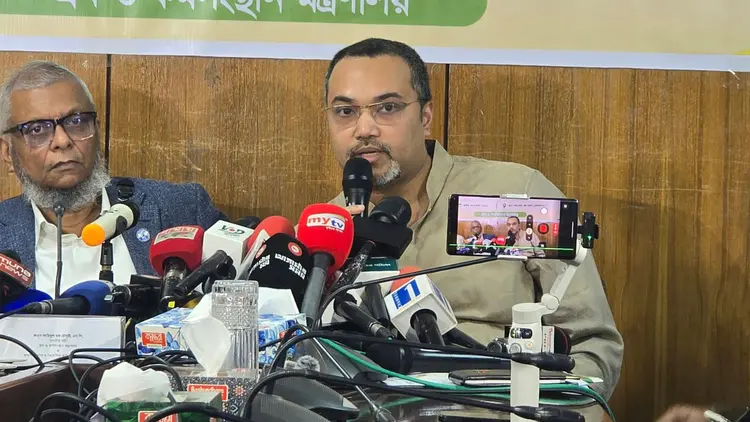
Prime Minister's Adviser Mahdi Amin stated that over the past three years, wages for garment workers across four grades increased on average by 36% to 43%. Despite various global challenges and constraints, the government formed a new wage board in the shortest possible time keeping workers' interests in mind—yet the government had no involvement or influence in determining the wages, with the wage board setting the new wage structure through a completely independent, impartial, and democratic process.
He made these remarks on Thursday noon, November 26, 2026, at a press conference on the minimum wage of garment workers held at Shrama Bhaban.
Wage Board Process, Vote on Disputed Grade & Salary Figures
Mahdi Amin said a labor-friendly labor law was passed in a very short time after the government took office. Global challenges have emerged due to war in the Middle East, and there is also an energy crisis across various industries in the country; even so, for the first time in history, a wage board was formed within three years instead of the previous five years.
He noted that every member of this wage board is highly acceptable and widely respected, fulfilling their duties impartially to safeguard the interests of both workers and industry, with worker representatives representing all workers and the employer representative known as a labor-friendly businessperson.
According to the Prime Minister's Adviser, the wage board determined the minimum wage independently and impartially through discussion and review among worker, employer, and neutral representatives in a democratic manner, without any government involvement or influence.
He explained that consensus was reached unanimously in three of the four grades for garment workers, while in one grade a decision was reached democratically by vote—where the workers' final proposal was 18,000 taka and the employers' proposal was 16,000 taka, resulting in a middle figure of 17,000 taka through voting.
Presenting a comparative picture of wage increases, Mahdi Amin said average wages rose by 36% to 43% across the four grades. In Grade-1, the wage was 15,035 taka in 2023 and has now been set at 21,500 taka—an increase of 6,465 taka, or 43%. With bonuses and overtime added, he said workers' monthly take-home pay will reach an even better and more dignified level, adding that citing employer representatives, many owners expect a large share of workers can take home up to 25,000 taka at month's end.
Welfare Measures, Rent & Fare Controls, Energy & Factory Harmony
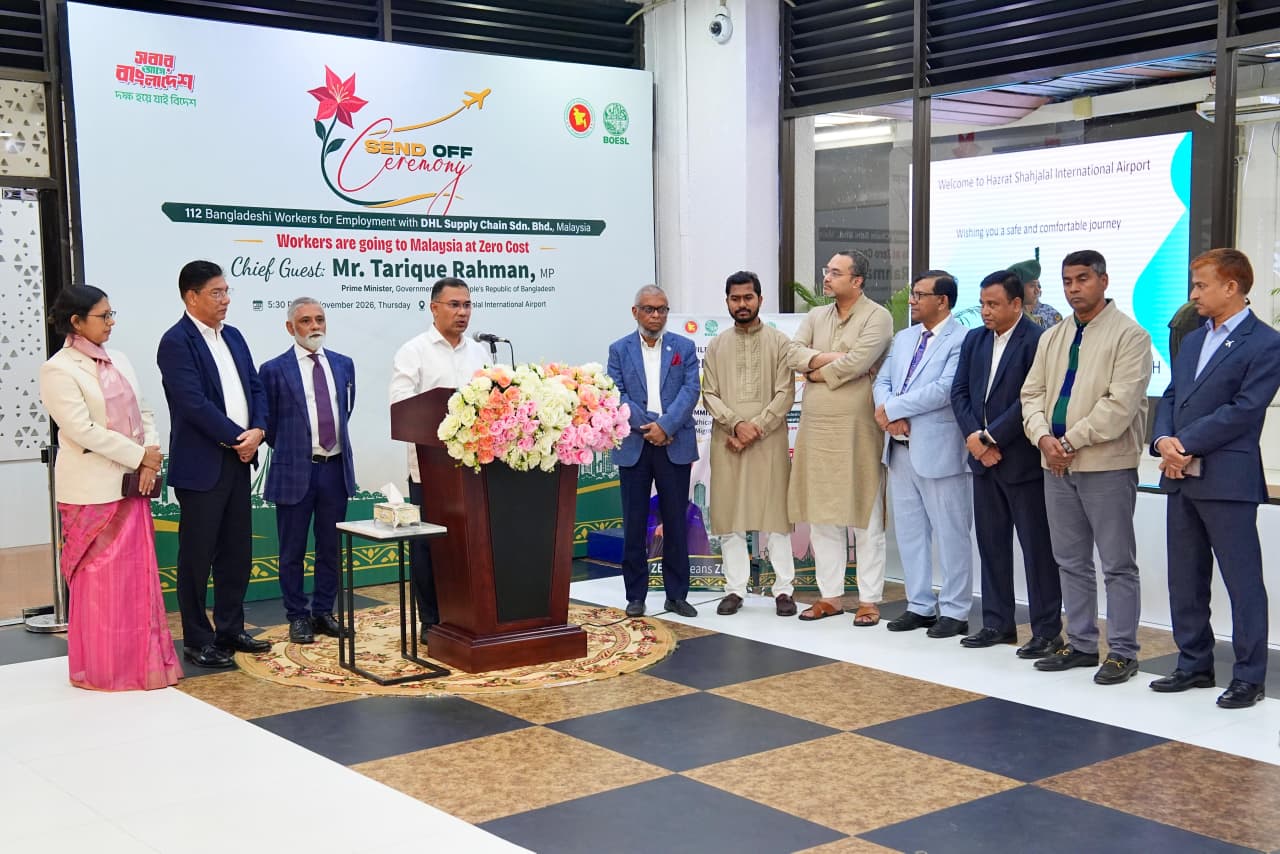 Read nextPM Tarique Rahman inaugurates zero-cost manpower export to Malaysia, sees off first batch of 112 workers
Mahdi Amin said inflation, cost of living, rising expenses, wages in other Bangladeshi industries, industrial capacity, conditions of large, medium, and small factories, and wage structures in competitor countries were all weighed by the wage board. While the government had no direct role in setting wages, it supported the process and prioritized workers' welfare under the Prime Minister.
Beyond the Ministry of Labor and Employment, the Prime Minister has instructed several ministries to protect workers:
- Subsidized Rice (OMS): OMS trucks are already delivering subsidized rice to worker-concentrated areas, and the Ministry of Food has been instructed to expand this further.
- Seven Specialized Hospitals: Expanding on the Prime Minister's parliamentary announcement of six specialized hospitals in worker areas, the number has been increased to seven based on worker feedback, complete with diagnostic centers, with land acquisition ongoing.
- Family Cards: Work is underway to introduce family cards for garment workers rapidly under the Ministry of Social Welfare, planned in female workers' own names and male workers' wives' names, with priority for the garment sector.
- Curbing Rent & Bus Fare Hikes: To stop sudden house-rent increases and higher transport/bus fares following wage rises, the Ministry of Local Government is holding talks with city corporations, pourashavas, upazilas, and unions—including steps to end sudden rent hikes permanently through law enforcement—while the Ministry of Road Transport and Bridges is taking measures against sudden bus fare increases.
- High-Rise Worker Housing & Energy Supply: Discussions with the Prime Minister on building large apartments or high-rise buildings for worker housing in worker hubs were met very positively, alongside multi-pronged energy measures including installing a third FSRU and diversifying fuel sources.
Urging factories to remain peaceful, boost efficiency and productivity, and see capable employers pay above the minimum while all comply with the law, Mahdi Amin said workers, employers, and the government must move forward together under the "Made in Bangladesh" banner.
— Daily Best News Desk • Fearless in the search for truth
Reported by Staff Reporter • Edited by the Daily Best News desk. Send corrections to [email protected].