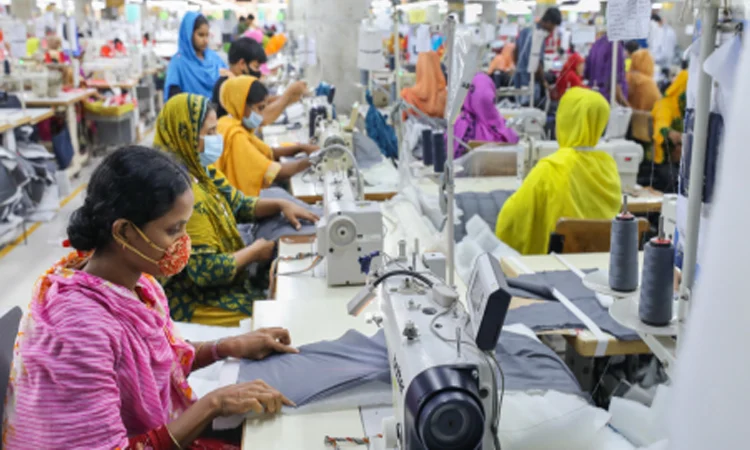
Bangladesh's ready-made garment (RMG) exports grew 6.10 percent year-on-year in the first quarter (July-September) of FY2026-27, reaching US$10,578.56 million against $9,970.42 million in the same period of FY2025-26, according to data released by the Export Promotion Bureau (EPB).
Knitwear exports rose 6.88 percent to $5,963.76 million, while woven exports grew 5.11 percent to $4,614.80 million during the first quarter.
United States (US), United Kingdom (UK) and Canada:During the first quarter of the current fiscal year (FY27), the US, the largest single-country market, imported $2,220.86 million, up 10.40 percent from $2,011.70 million. Its share rose from 20.18 percent to 20.99 percent. Knitwear shipments grew 11.61 percent to $881.28 million, and woven shipments 9.61 percent to $1,339.58 million.
Exports to the UK increased 5.94 percent to $1,292.13 million. Knitwear rose 10.00 percent to $897.93 million, while woven fell 2.27 percent to $394.20 million. The UK's share was almost unchanged at 12.21 percent.Canada took $349.65 million, up 3.85 percent. Knitwear edged up 1.07 percent to $181.98 million, while woven grew 7.04 percent to $167.67 million.
Non-traditional markets: Exports to non-traditional markets during this July-September period rose 9.40 percent to $1,811.89 million from $1,656.28 million, lifting their share from 16.61 percent to 17.13 percent. Knitwear grew 9.94 percent to $889.34 million and woven 8.87 percent to $922.55 million.
Turkey was the standout performer, with shipments more than doubling (up 123.14 percent) to $146.63 million. Brazil rose 41.58 percent to $63.09 million while the UAE 18.67 percent to $74.34 million, and Mexico 14.77 percent to $81.72 million.
In addition, South Africa grew 9.29 percent to $37.85 million, South Korea 8.81 percent to $120.94 million, Malaysia 6.31 percent to $47.80 million and Saudi Arabia 5.67 percent to $51.64 million.
Japan, the largest non-traditional market, grew 2.61 percent to $343.65 million. Australia rose 1.02 percent to $209.06 million, and China was nearly flat at $71.21 million (up 0.09 percent). Other countries combined grew 14.45 percent to $253.24 million.
The European Union: The EU remained the largest destination bloc, importing $4,904.02 million of Bangladeshi apparel, up 3.33 percent from $4,746.10 million. Knitwear shipments rose 4.29 percent to $3,113.23 million, and woven shipments 1.70 percent to $1,790.79 million.
The EU's share of Bangladesh's total apparel exports, however, slipped slightly from 47.60 percent to 46.36 percent.
Among individual EU members, Germany, the largest buyer, was nearly flat at $1,122.98 million (down 0.15 percent). Spain grew 13.73 percent to $1,148.46 million, the Netherlands 9.02 percent to $597.49 million, and Poland 5.77 percent to $401.93 million. Sweden rose 14.43 percent to $177.00 million, and Belgium 1.39 percent to $130.09 million.
Other EU markets with growth included Romania (60.03 percent to $47.85 million), Hungary (25.46 percent to $44.95 million), Slovakia (27.56 percent to $19.86 million) and the Czech Republic (1.28 percent to $72.35 million). Smaller gains were seen in Latvia (59.29 percent to $0.53 million) and Malta (50.32 percent to $0.10 million).
Talking to BSS, former BGMEA Director Mohiuddin Rubel said Bangladesh's apparel export growth in the last month remained encouraging despite the energy crisis and rising production costs, while non-traditional markets and the United States showed stronger growth than the overall export trend.
He said the export performance should be viewed in the context of the challenges faced by the apparel industry, particularly the energy crisis, which has increased pressure on production and business operations.
"Although the export figure may appear relatively low in absolute terms, the growth achieved amid the current energy crisis is definitely positive," Rubel said.
He identified the improved performance in non-traditional markets as a particularly encouraging development, noting that Bangladesh had struggled to achieve satisfactory growth in these markets for a considerable period.
According to him, export growth in non-traditional markets and the United States has exceeded the overall growth rate, indicating that Bangladesh is gradually improving its position beyond its traditional export destinations.
Rubel, also the Founder and CEO of Bangladesh Apparel Voice (BAV), said Bangladesh needs to reduce its excessive dependence on Europe and the United States by exploring opportunities in other markets, including Japan, Australia and India.
"Europe's performance has not been particularly strong. Therefore, we need to diversify our export destinations and explore the significant opportunities available outside the major traditional markets," he said.Bangladesh had maintained its position in the US market and that further export growth remained possible there, he added.Rubel, however, stressed that export growth alone would not be sufficient to ensure the long-term sustainability of the garment industry.
"Growth must be profitable and sustainable. We need to manage the rising costs and focus on higher-quality products and markets where we can achieve better returns," he continued.
Rubel said the recent improvement in monthly export performance offered some encouragement, adding that continued growth in the coming months could help the sector move closer to its overall annual target.
"If we can maintain the positive trend and continue to achieve incremental growth every month, we may be able to move closer to achieving our overall growth target." he said.
Rubel also emphasised that market diversification, product quality, cost management and profitable expansion would remain crucial to strengthening Bangladesh's position in the global apparel market.
— Daily Best News Desk • Fearless in the search for truth
Reported by Daily Best News Desk • Edited by the Daily Best News desk. Send corrections to [email protected].