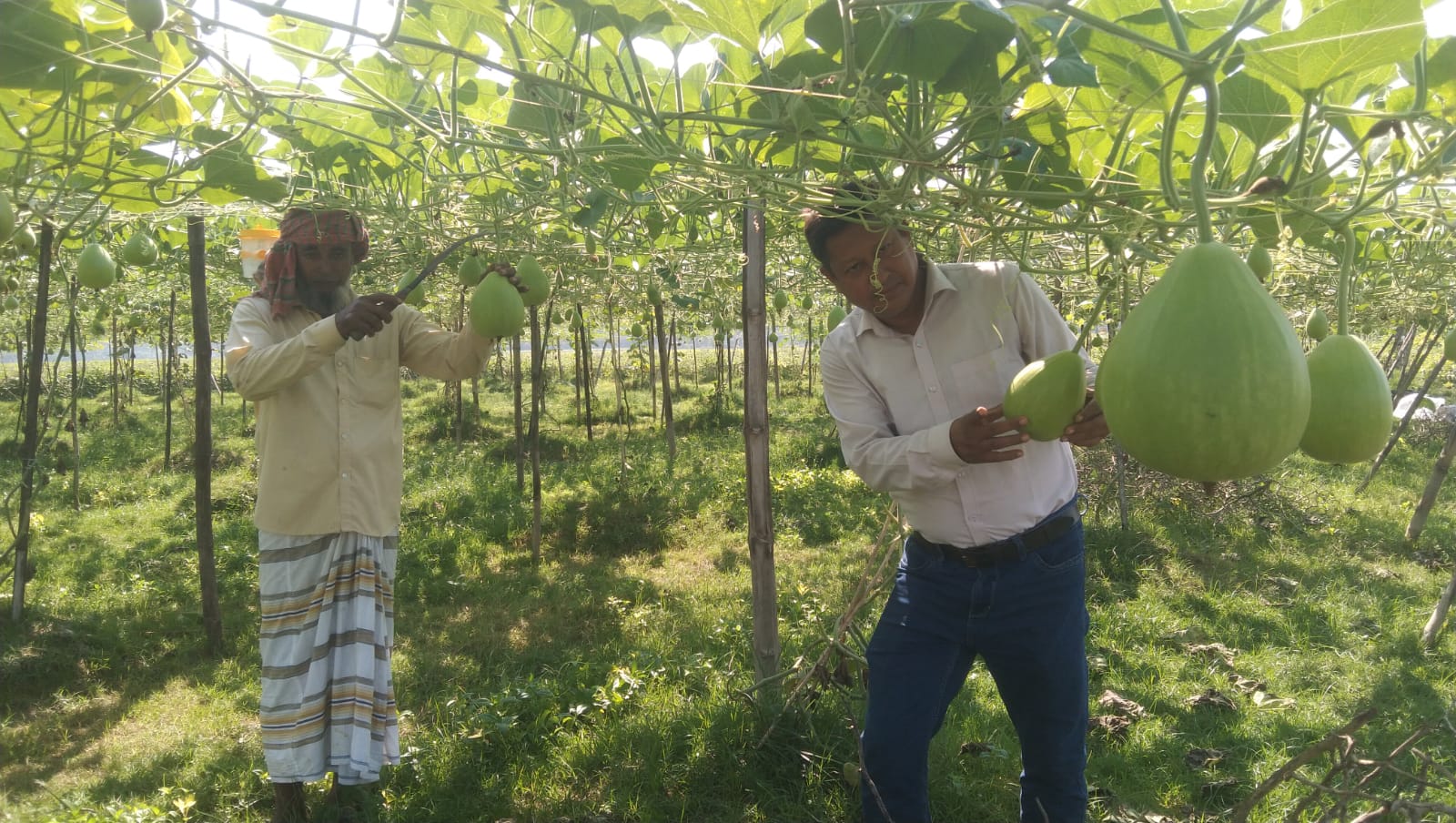
Leasing one and a half bighas of fallow land for 25,000 taka, farmer Hannan of Jalaler Dhal village under Atghoria pourashava has commenced cultivating 'Gol Bindu' gourds using the trellis (macha) method. Cultivation of Gol Bindu gourds via trellises has expanded across this vegetable-renowned upazila. Although gourds are typically a winter vegetable, local farmers are cultivating them year-round.
Cultivating gourds through this method minimizes pest attacks. Because farming is conducted without applying pesticides, gourds produced in this upazila enjoy nationwide demand.
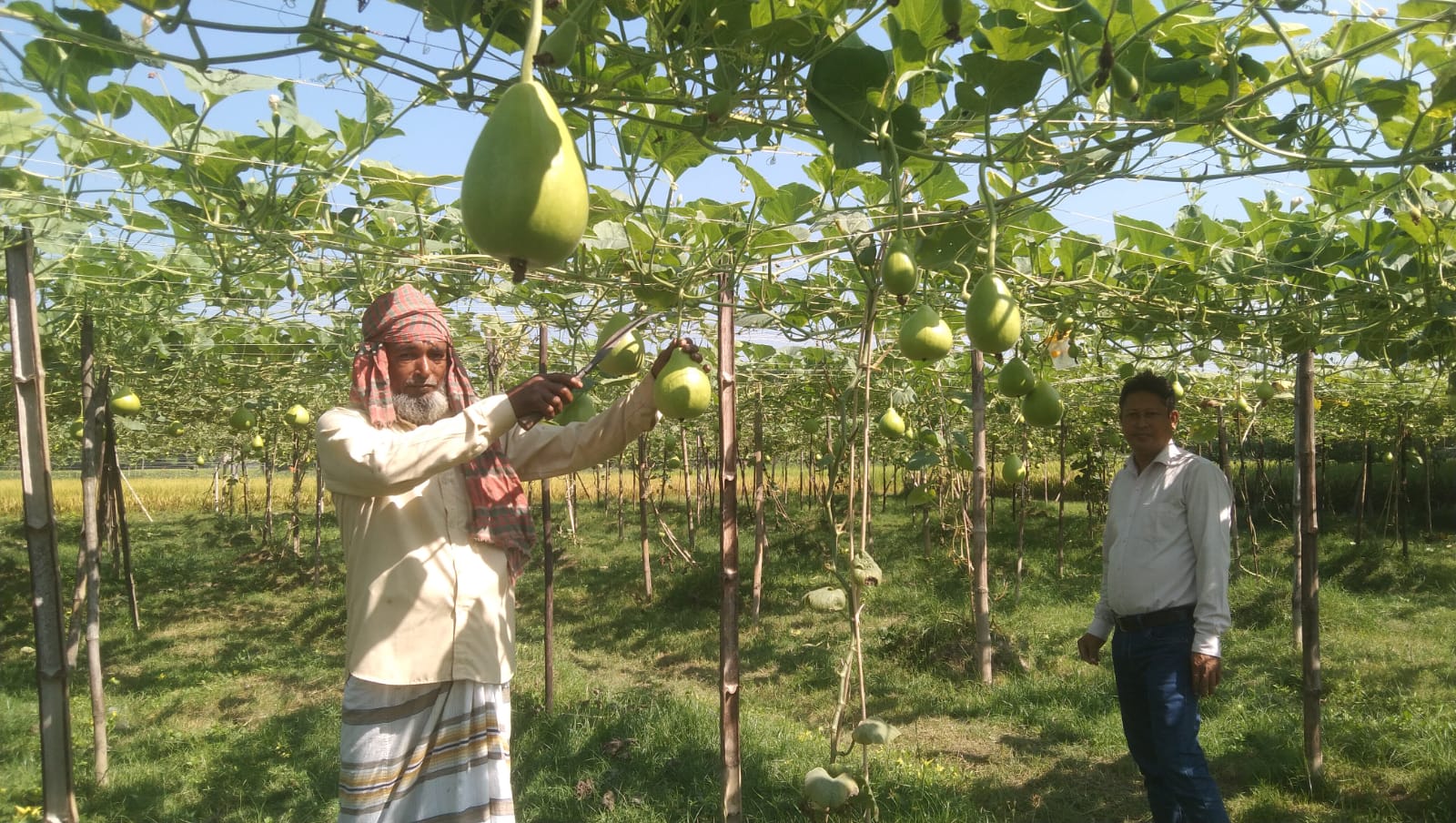
Inspired by farmer Abdul Hannan's success, many others are taking up Gol Bindu gourd cultivation, prompting a steady rise in gourd farming across the upazila. The relevant agriculture department expressed optimism that low costs and high profits will drive further expansion in gourd cultivation.
Following advice from the upazila agriculture office as he does every year, Hannan planted Gol Bindu gourd seedlings across one and a half bighas of land. Expenses for land preparation up to fruit setting ranged between 25,000 and 30,000 taka. In the current season, he has sold approximately 1.5 lakh taka worth of gourds so far.
Local farmers stated that cowdung, ash, water hyacinth, and water are primary inputs for gourd cultivation, with chemical fertilizers playing almost no role. Consequently, production costs per bigha rarely exceed 25,000 to 30,000 taka.
Compared to other crops, gourd cultivation requires relatively less labor. Owing to high consumer demand as a winter vegetable and favorable market prices, gourds cultivated per bigha can fetch between 230,000 and 240,000 taka. Additionally, selling gourd shoots (doga) generates supplementary income.
Due to lower comparative labor and expenditure, the trellis method has gained significant popularity. Rejoicing over high yields and favorable prices, gourd farmers are receiving advisory and technical support from the agriculture department to encourage cultivation alongside new vegetables.
Gourd grower Abdul Hannan remarked, "I could not recover even half of what I spent on other crops. Fertilizer, pesticide, and irrigation costs for paddy farming have doubled. This year, I cultivated the Gol Bindu gourd variety using the trellis method. Irrigation and labor costs are low, and pest attacks are virtually nonexistent. As a result, avoiding pesticides allows people to receive poison-free vegetables."
Local gourd farmers noted that trellis cultivation of Gol Bindu gourds incurs very low expenses, resulting in exceptional yields and reasonably good market prices. While long-variety gourds experience slightly lower demand, round native varieties enjoy robust demand, drawing wholesale traders from various districts to purchase produce directly from their fields, ensuring profitability.
Visiting various fields across Atghoria pourashava, Chandva, Majpara, Khidirpur, Parakhidirpur, Sorabaria, Debottar, Ekdant, and Lakshmipur, fertile agricultural lands displayed systematically arranged trellis gourd farming, with high-yielding gourds hanging thickly from vines. Currently, gourds wholesale locally between 30 to 35–40 taka depending on size, bringing joy to farmers.
Vegetable traders at Debottar Bazar stated that farmers sell gourds at their commission shops daily, while wholesalers purchase in bulk to supply major metropolitan markets including Dhaka, Sylhet, Barishal, and Chattogram.
The smooth, attractive appearance and delicious taste of locally produced gourds drive strong demand, bringing mutual profitability to farmers and traders alike while fulfilling vegetable demands in non-vegetable-growing regions.
Sub-Assistant Agricultural Officer for the pourashava block Jahidul Haque noted that local farmers achieving profitability through early Gol Bindu gourd cultivation play a crucial role in closing vegetable supply gaps.
Atghoria Upazila Agriculture Officer Agriculturist Mahmuda Motmainna stated that while gourds are conventionally winter vegetables, early pre-winter cultivation has gained popularity. Among various varieties such as Diana, Ziran, Martina, Shitalau, Lucky, Marshall, and Gol Bindu, trellis cultivation at the tail end of the monsoon and onset of winter—promoted through field days—has brought substantial profits to farmers.
— Daily Best News Desk • Fearless in the search for truth
Reported by Md. Masud Rana, Atghoria (Pabna) • Edited by the Daily Best News desk. Send corrections to [email protected].