A ring embankment constructed at a cost of Tk 1.4 crore with funding from the United Nations World Food Programme (WFP) has collapsed within just two months in Barguna, raising allegations of irregularities and inadequate supervision during construction.
Local residents and concerned stakeholders have blamed JAGORANI, the local development organisation involved in facilitating the project, for the failure. However, the organisation has denied responsibility, while the contractor has attributed the collapse to alleged design flaws. The upazila administration has assured that the matter will be investigated and necessary action taken.
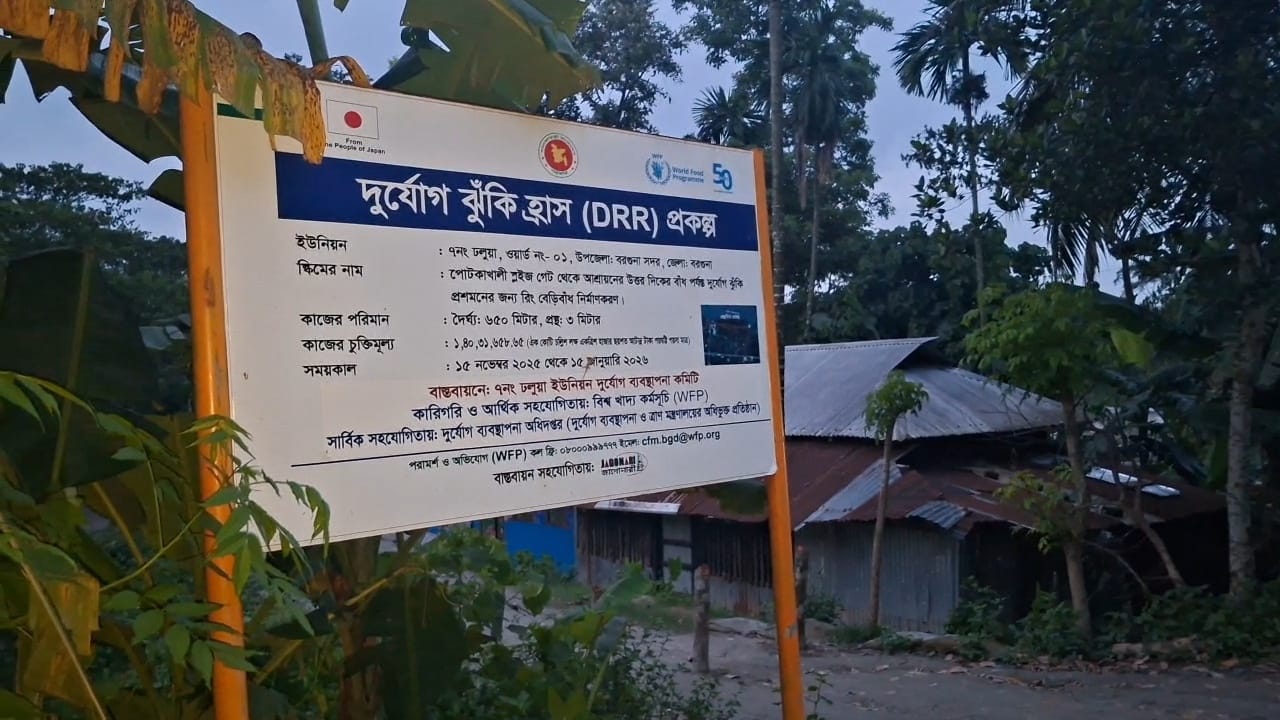
According to project documents, the ring embankment was constructed to reduce disaster risks at the Potokakhali Ashrayan Project, located along the Khakdon River in Dhalua Union of Barguna Sadar Upazila. The project was funded by WFP at a cost of Tk 1.4 crore, with local development organisation JAGORANI involved in facilitating implementation.
Local residents alleged that inadequate supervision and irregularities in construction led to the collapse of sections of the embankment and its guide wall. They also claimed that although 40 percent of the required soil was supposed to be transported from a distant location, soil was instead excavated from a nearby canal and used in the embankment.
Residents further alleged that the project initially called for the construction of a 650-metre embankment, but only 628 metres were ultimately built. They have questioned the quality of the work and the role of the organisation responsible for overseeing the project.
Residents Raise Questions Over Construction Quality
Al Amin, a resident of the Potokakhali Ashrayan Project, said the guide wall could have remained intact if it had been properly constructed. He alleged that soft soil was used in the embankment, making the structure vulnerable to collapse.
Another resident, Md. Nannu, alleged that the work would have been of better quality if the responsible authorities had properly inspected and supervised the contractor's activities. He claimed that JAGORANI failed to provide adequate oversight.
Md. Babul Khan, another local resident, said soil had been excavated from the adjacent canal using an excavator. According to him, the resulting excavation weakened the ground supporting the embankment and guide wall, causing sections of the structure to collapse into the canal.
Nasima, a resident of the Ashrayan Project, said soil had been collected from the canal during low tide and used to construct the embankment. She also complained that the project had failed to provide adequate drainage, leaving nearby homes vulnerable to rainwater accumulation.
She said a drainage system should have been included in the project to allow water to flow away from residential areas.
Former member secretary of the Dhalua Union BNP, Md. Moniruzzaman Babul Molla, also alleged serious irregularities in the project. He claimed that the allocated funds should have been sufficient to construct several similar embankments and alleged that a substantial portion of the money had been misappropriated. These allegations have not been independently verified.
JAGORANI Denies Responsibility
Hosen Ara Hashi, chief executive of JAGORANI, denied the allegations of poor construction and said the project was implemented through the union parishad.
She explained that WFP facilitated the funding through the organisation, but the money was transferred directly to the union parishad. According to her, a committee headed by the Upazila Nirbahi Officer (UNO), with representatives from relevant technical and disaster-management offices, was responsible for overseeing the work.
She said the committee inspected the work and submitted its report before the union parishad released the funds. She added that she was not an engineer and that responsibility for assessing technical quality rested with the relevant authorities and engineers.
However, she maintained that the construction quality had been satisfactory.
Contractor Blames Design Flaw
Contractor Mostafa Zaman Milton denied allegations of irregularities and attributed the collapse to a design issue.
He claimed that the embankment slope was designed at a ratio of 1:2 instead of 1:3, allowing rainwater to penetrate gaps and cause portions of the structure to slide into the canal.
He said the damaged sections would be repaired after the rainy season ends.
Officials Dispute Their Involvement
Md. Zahirul Islam, project implementation officer at Barguna Sadar Upazila, said JAGORANI had informed his office that the project would be implemented in accordance with government procedures.
He said he had assisted with the tender process but was unaware of the construction quality or whether the work had followed the approved plan. Although his office's name appeared on the project signboard, he said his office had not been involved in project inspections or implementation.
Md. Mehedi Hasan, executive engineer of the Local Government Engineering Department (LGED) in Barguna, said his office had only been involved in preparing the project estimate through the upazila engineering office. He said no LGED officials had participated in the implementation process and that his office had not issued any clearance for the work.
Md. Abdul Hannan Pradhan, executive engineer of the Bangladesh Water Development Board in Barguna, said the agency had learned that a private organisation had undertaken work to protect residents living outside the existing embankment system at Potokakhali.
He said the board would have provided technical assistance if requested, but no such support had been sought.
Md. Zia Molla, a member representing Ward No. 7 of Dhalua Union Parishad and a member of the union disaster management committee, claimed that JAGORANI had carried out the construction work, while the union parishad had mainly handled the financial transactions.
However, Md. Shakhawat Hossain, administrator of Dhalua Union Parishad and chairman of its disaster management committee, disputed JAGORANI's claim that it had no direct responsibility. He said the organisation had been involved in supervising the work and coordinating with the union parishad, which primarily released the payments.
Upazila Administration Promises Investigation
The Upazila Nirbahi Officer (UNO) of Barguna Sadar said the damaged embankment was repairable and that the authorities had been informed it would be repaired using the contractor's security deposit.
The UNO said the administration had received information about the collapse but had not previously been formally informed of the allegations of irregularities described by local residents.
The official added that the administration would investigate the allegations and take appropriate action based on the findings.
— Daily Best News Desk • Fearless in the search for truth
Reported by Jahidul Islam Mehedi District Correspondent • Edited by the Daily Best News desk. Send corrections to [email protected].