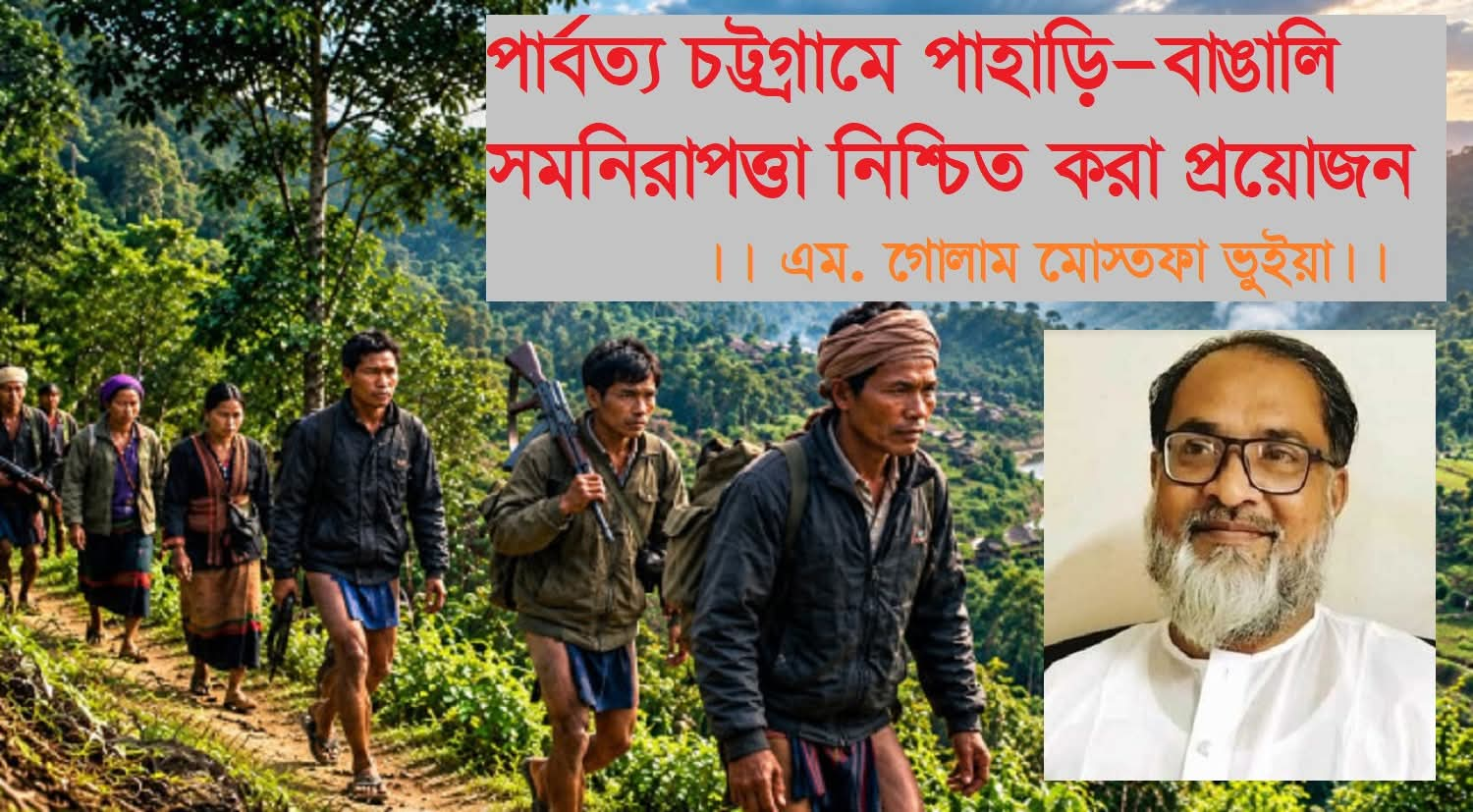
The public lacks a clear idea as to who is creating instability and supplying arms in the Chittagong Hill Tracts (CHT), and clarifying this perception is the government's responsibility. Suddenly, from time to time, attempts are made to unrest the CHT. The underlying reasons for this unrest in the hills remain unclear to the general public. The government itself must clarify before the citizens who are instigating instability in the hills, and how separatist and terrorist groups are operating and conspiring.
For the past four decades, a large number of Bangladeshi citizens (people from the plains) have settled and resided across the three hill districts of the CHT. Following the Chittagong Hill Tracts Peace Accord, extensive development occurred, maintaining peace and order in the hills. Even during the 15-year rule of the fallen regime, no disruption to peace or public order was observed in the region. The question arises: why are attempts being made to unsettle the CHT now under the interim government and the currently elected government following the mass movement of '24? Who is behind these attempts? According to social media reports, following the formation of the interim government, a group of ethnic minority students wrote a letter to Indian Prime Minister Narendra Modi. Has the conspiracy behind this audacity come to an end?
An indefinite road blockade is currently underway on the road to the Sajek Valley tourist area in Baghaichhari upazila of Rangamati. The Sajek Rights Protection Committee and the Sajek Karbari Association have been enforcing this program for the third phase since October 22 to realize their five-point demand. Members of law enforcement agencies were present at key locations. Because the Sajek tourist center remains closed due to security concerns, tourist movement and tourism-dependent business activities have ground to a halt. To resolve the Sajek crisis, a meeting was held on October 26 at Ujo Bazar between administrative representatives and the blockaders. Khagrachhari Member of Parliament and Chairman of the Parliamentary Standing Committee on the Ministry of Chittagong Hill Tracts Affairs Abdul Wadud Bhuiyan, Rangamati Member of Parliament Dipen Dewan, alongside Deputy Commissioners and police officials from both districts, were present at the meeting.
During the meeting, discussions took place regarding the five-point demand of the blockaders. In his post-meeting address, Abdul Wadud Bhuiyan informed that consensus had been reached on four of the five demands, while the remaining demand required further discussion. As a final agreement could not be reached on the primary demand, the blockaders announced the continuation of the blockade. Consequently, an immediate solution regarding the normalization of road transit was not achieved even after the meeting, and the crisis created in tourism, goods transport, and local livelihoods due to the blockade remained unresolved.
Once bustling with tourists, Sajek in the hills featured crowded resorts and cottages, busy restaurant services, and active livelihoods centered around tourism. That very Sajek has now fallen silent. There are no guests in resorts and cottages, familiar bustle is absent from restaurants, and stocks of daily necessities in shops are dwindling. Due to the absence of tourists, earnings for many people have completely stopped. Meanwhile, anxieties regarding the supply of food items, fuel, and emergency medicines are mounting. Keeping vehicles and communication channels operational to transport severely ill individuals or accident victims to hospitals has become a major challenge. If such a situation persists in remote hilly settlements, children, the elderly, and the sick will be the most impacted. Unless resolved swiftly, further severe complications may arise.
The crisis created in tourism, freight transport, and local livelihoods due to the blockade remains unmitigated. Under these circumstances, alongside political and administrative solutions to the blockade, demands for urgent measures to safeguard ordinary people's lives and livelihoods are growing stronger. In particular, implementing effective arrangements on humanitarian grounds to deliver food items, life-saving medicines, and medical supplies is critical. However, the most alarming aspect is that the deadlock resulting from internal conflicts among regional groups in Sajek, Rangamati, has now spread beyond Sajek to paralyze vast settlements across Rangamati and Khagrachhari. Transport movement remains suspended due to the continuous indefinite road blockade, long-distance buses are not departing, and a tense panic grips the hill settlements. Although law enforcement agencies claim to keep the situation under control, no visible signs of alleviating the suffering of ordinary citizens are observed.
When the CHT Peace Accord was signed in 1997, the primary character of the conflict was internal, seeking a political resolution to the armed movement active against the state for autonomy. The current situation is far more complex. A major portion of Rakhine State in Myanmar is now under the control of the Arakan Army. Consequently, a vital portion of Bangladesh's border faces a territory virtually controlled by a non-state armed group. On the other hand, within the CHT, allegations of attacks, killings, and armed activities centered around the Kuki-Chin National Front (KNF) have surfaced in recent years. Allegations of linkages with various armed groups in Myanmar and India have further complicated the situation. Because risks of illicit arms, narcotics, and armed individuals moving across border regions exist, security vacuums in one zone can rapidly impact other areas. Furthermore, among certain marginalized groups in the broader region, separatist or religious-geopolitical concepts centered around the Kuki-Chin-Mizo community are being propagated. Although widespread public support for these ideas lacks proof, armed groups or external powers may find opportunities to exploit them in an unstable environment.
While viewing border protection and counter-terrorism as crucial responsibilities of the state, equal importance must be attached to the security and confidence of the people in the hills. Long-term stability cannot be ensured solely through military or law enforcement measures. What is required is an integrated security framework where the military, civil administration, local institutions, and representatives of the hill communities work collaboratively. Alongside border security, the lives, property, rights, and security of local populations must be guaranteed. Concurrently, development, administrative capacity, transport infrastructure, and inter-community trust must form part of the national strategy.
The terminology of "indigenous" and "settler" is completely illogical; neither history, sociology, nor anthropology supports such a relationship. All residents must be considered as Bangladeshis and inhabitants of the Chittagong Hill Tracts, while according equal respect to all as ethnic groups. To achieve a permanent solution to the situation, the government may consider establishing a Truth and Justice Commission, while safeguarding national security interests, on which no compromise can be made. Formed in the shortest possible time, this "Justice Commission" would investigate and uncover the truth regarding all forms of oppression suffered by CHT residents, whether committed by state or non-state individuals or entities. To establish lasting peace, ensuring equal security, civil rights, and peaceful coexistence for all people—Bengali and non-Bengali (hill residents)—in the hill region is the responsibility of the state. Without considering political identity or ethnic background, the security of life and property of ordinary citizens and legal action must be ensured. High priority must be given to conducting joint operations to halt dominance struggles, extortion, abductions, and armed violence in the hills. Offenders—whether Bengali or tribal, Hindu or Muslim—must be brought to justice based on fairness. Protecting the fundamental human rights of citizens is the primary responsibility of the state, and the government must remain vigilant so that this priority is never sidelined.
The previous government failed completely to establish stability and long-term peace in the hills. The current government should pursue a political solution by engaging all parties at the community level to fulfill the policy imperative of maintaining Bangladesh's state integrity and sovereignty. While maintaining sensitivity toward protecting civil rights, the highest measures must simultaneously be adopted to counter threats to state stability and security. Care must be taken to ensure no shortfall in protecting human rights under any circumstances. Vigilance against foreign conspiracies must be maintained, and security forces must prepare their operational framework in accordance with international human rights standards and globally recognized conventions. The Peace Accord signed in 1997 led the hill population toward division. Radial amendments to various clauses of the Peace Accord are also a demand of the time. The government should form a high-level commission in this regard. By eliminating the constitutional limitations of the Peace Accord through timely re-evaluation, equitable distribution among all ethnic groups, and developing local leadership, lasting peace and national unity in the hills can be secured.
To ensure equal security for the hill people, Bengalis, and other communities in the Chittagong Hill Tracts, the patriotic military and law enforcement agencies should adopt well-formulated plans. Establishing peace in the hills does not merely mean halting gunfire; rather, it entails guaranteeing human security, justice, rights, dignity, and economic potential. Whoever possesses illegal arms, compromises ordinary citizens' safety, or engages in armed violence must face legal action based on evidence, regardless of their identity or political position. Alongside ensuring punishment for offenders, the rights and dignity of innocent citizens must be safeguarded. Care must be taken so that no innocent person falls victim to harassment or injustice under the guise of establishing security. Concurrently, it must be ensured that no armed group escapes accountability for illegal activities under the pretext of human rights or ethnic identity. To establish permanent peace in the CHT, alongside halting the proliferation of illegal weapons, neutral investigations and effective remedies regarding allegations of extortion, abductions, armed dominance, and intimidation must be guaranteed. Concurrently, long-standing land disputes, political mistrust, rights crises, and development disparities must be addressed through dialogue.
The lives, dignity, and rights of all community members—hill residents, Bengalis, and non-Bengalis alike—are equally important. Securing permanent peace requires more than security measures; the government must take initiatives to resolve long-standing issues such as land disputes, political mistrust, and development disparities. Owing to conflicting statements from various sides regarding recent events, the true facts must be uncovered through a comprehensive, neutral, and credible investigation. Determining who opened fire, who incited violence, who endangered public safety, and whether any innocent individuals suffered unjust treatment must be established based on concrete evidence. It must be remembered that security in the hills does not depend solely on security forces stationed there. If residents of border settlements feel safe, protected, and stakeholders in the state, the security framework will be sustainable. Therefore, the goal should be not merely keeping the hills safe, but making the hills safe alongside the people of the hills. Terminology such as indigenous, ethnic minority, settler, and settler-Bengali must be discarded in the Chittagong Hill Tracts. Equitable distribution among all must be executed to resolve CHT problems. Landless individuals in the hills must be provided with land. Dreams must be envisioned collectively for all ethnic groups rather than focusing on a Chakma-centric vision alone. Only then will neighboring states or Western powers be unable to execute any conspiracies concerning the Chittagong Hill Tracts.
Many advocate for peace in the Chittagong Hill Tracts without military presence, but the CHT is a special area. However, they overlook the fact that sovereignty and territorial integrity remain preserved in the CHT precisely because of the military. In the interest of national security, the administrative order established during the 1980s or 1990s must be reinforced. They must be persuaded through negotiations so that neighboring countries can no longer conspire. Whenever issues arise in the hills, our intellectuals issue one-sided statements or comments. The statements they issue without properly understanding or knowing create an adverse reaction in the minds of the Bangladeshi public. Intellectuals must be restrained from issuing one-sided statements. Had all clauses of the Peace Accord been implemented, problems in the hills would have significantly diminished. However, issues and constitutional conflicts exist within these clauses. Re-evaluating or reviewing the Peace Accord is an absolute necessity; without this re-evaluation, resolving the hill crisis is impossible.
Establishing peace in the Chittagong Hill Tracts is not a new issue, but a long-standing one. Political and security analysts express concern over whether that territory can be retained within Bangladesh's future without establishing peace. Falling victim to international plots is a natural hazard; international conspiracies and plots by enemies of the state will persist. But to withstand them, what is most needed is our national unity. On these matters, everyone must unite irrespective of party alignment, opinion, or ethnicity, and politicians must stand together.
(Author Profile):
M. Golam Mostofa Bhuiyan (Politician, Political Analyst, and Columnist) E-mail: [email protected]
— Daily Best News Desk • Fearless in the search for truth
Reported by M. Golam Mostofa Bhuiyan, Political Analyst and Columnist • Edited by the Daily Best News desk. Send corrections to [email protected].