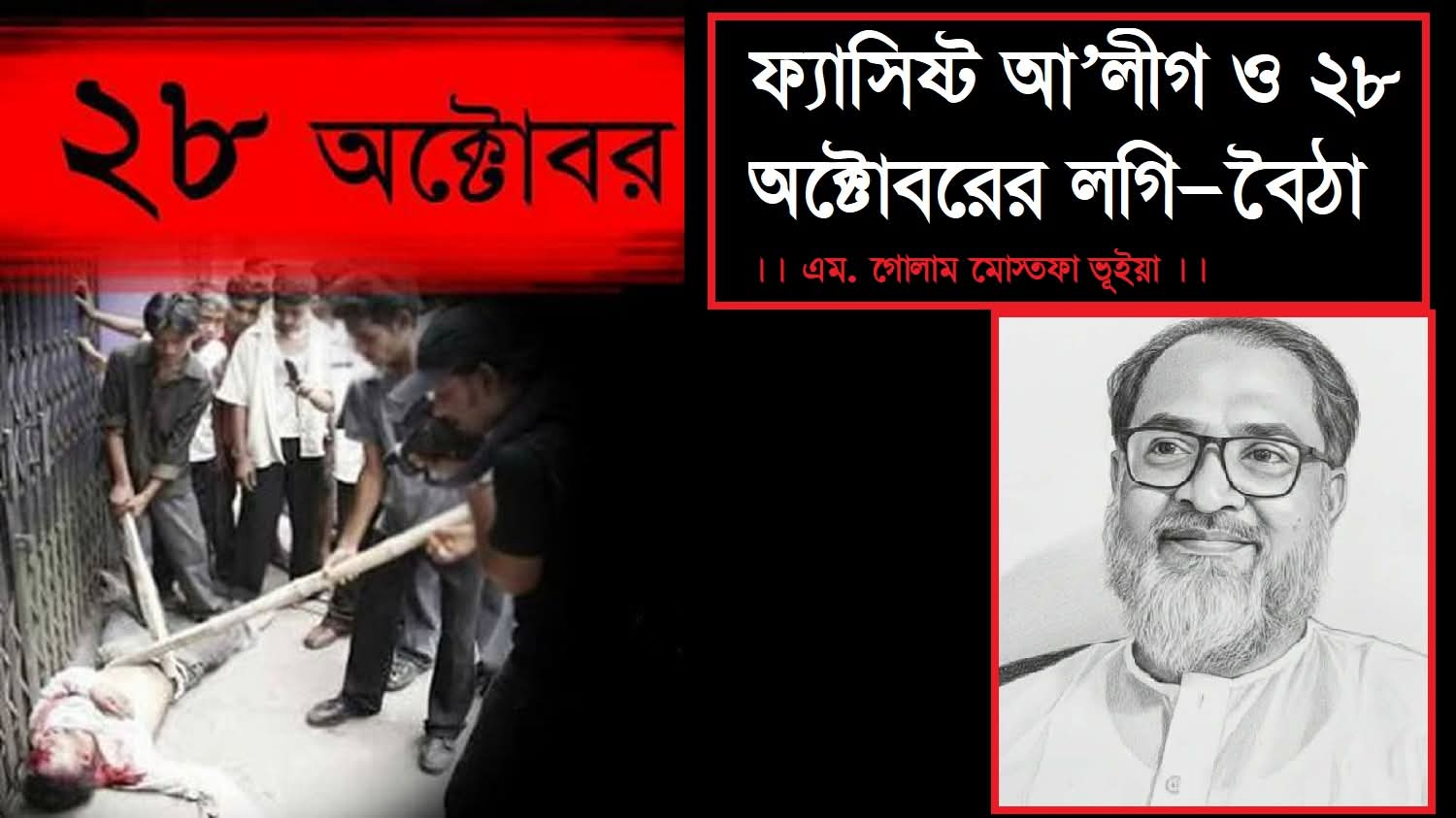
The clashes between the Awami League and Jamaat-e-Islami in the Paltan-Baitul Mukarram area of Dhaka on October 28, 2006, are referred to as the "savagery of logi-boitha" (poles and oars). It witnessed the naked manifestation of the Awami League's horrific logi-boitha rampage, open use of arms, and human slaughter accompanied by brutality upon corpses. This created widespread uproar and marked a dark chapter in the political history of Bangladesh. The incident became known as the "savagery of logi-boitha" because it displayed the extreme form of violence and aggression. On this day in 2006, in broad daylight around the Baitul Mukarram area of the capital, Awami League activists brutally killed six leaders and activists of Jamaat-Shibir by beating them like snakes using logi-boitha. Not only that, but they also danced on the dead bodies after confirming their deaths—an unimaginable act in the civilized world. Naturally, a storm of condemnation erupted at home and abroad at that time. Two decades are about to pass since that logi-boitha rampage by the Awami League.
In 1757, the sun of Bengal's independence was eclipsed through a farcical battle at the mango grove of Plassey. That marked the beginning of the struggle and fight to reclaim Bengal's independence. Through a struggle and fight spanning nearly two hundred years, Pakistan was established on the map of the earth in 1947. However, although a British-free independent country was achieved, the people of Bangladesh could not attain self-determination and rights. The struggle and fight began anew—this time for self-determination, rights, and freedom. Through the Language Movement of '52, the Mass Uprising of '69, the Elections of '70, and finally the bloody Liberation War of 1971 at the cost of an ocean of blood, an independent and sovereign Bangladesh with its red-and-green flag was established on the world map. Even after independence in 1971, true freedom was not attained, and the fight and struggle resumed. The aspirations for democracy and freedom of speech, for which our struggle against Pakistani rulers had persisted since 1947 and which culminated in the Great Liberation War of 1971, were once again trampled upon.
Following independence, bypassing the call by the dreamer of an independent Bengal and leader of the oppressed, Mawlana Abdul Hamid Khan Bhashani, to form a national government, an Awami League partisan government was established. Immediately after the formation of the government, the old game of plunder and the establishment of single-party rule began. Right after independence, when Indian allied forces began looting Bangladesh's resources, Sector Commander of the Great Liberation War Major M. A. Jalil stood as a barrier to their misdeeds. Tragically, as a reward for his protest and resistance, the then government arrested him and sent him to prison, depriving him of his gallantry title of Bir Uttam. Right after independence, Major Jalil became the first state prisoner of independent Bangladesh. The Awami League government did not stop there; that was just the beginning. They subsequently stained their hands with the blood of nearly 36,000 patriotic political activists, including Comrade Shiraj Sikder. Except for four newspapers, all newspapers were banned, all political parties were prohibited, and on January 25, 1975, they strangled the multi-party politics—the pledge and spirit of the Great Liberation War—to establish a one-party BAKSAL.
The Awami League carries a political character such that it never tolerates its critics. When their founding president, leader of the oppressed Mawlana Bhashani, left the Awami League due to political differences to establish the National Awami Party (NAP), they did not hesitate for a moment to attack that very conference. They even murdered the then-Speaker of Parliament, Shahed Ali Patwary, inside the parliament. This is the Awami League character. October 28, 2006, is merely an expression of that old fascist character of the Awami League. On this day in 2006, the most heinous incident in history occurred in broad daylight at Paltan in the heart of the capital Dhaka. As a nation, it has shamed and humiliated us worldwide, raising questions about our civilization and humanity in the minds of civilized people across the globe. Conscious people can best tell whether dancing on dead bodies has ever happened in any movement in the past. October 28 is a stigmatized chapter for democratic politics and political parties in Bangladesh.
For peace-loving people, this day was unexpected, gruesome, and condemnable. This incident repeatedly reminds the nation of the Awami League misrule of '72–'75. There are certainly various political methods for government change, anti-government movements, or movements to realize demands, including hartals, blockades, and non-cooperation. But no conscious person can say that in any civilized country, in the name of realizing demands, opposition political activists have been ruthlessly killed and such savage dance-rampages have been executed publicly over their corpses. Why did a party claiming to be the champion of freedom and democracy commit such an incident, why did they formulate such a violent movement program, and why did their top leadership adopt this ominous program of logi-boitha? Just a day before the expiration of the four-party alliance government's term, why did they brutally kill six leaders and activists of the government's partner, Jamaat-e-Islami and Chhatra Shibir, publicly on the streets through logi-boitha and then dance savagely upon those corpses?
In democratic politics, the opposition Mahajote (Grand Alliance) should have exposed the flaws and shortcomings of the then four-party alliance government to the public and brought about a ballot revolution through that—that should have been politics. Instead of doing that, why this savagery? Although these questions arose in the public mind at the time, there were no answers. But now it seems the people did not have to wait long to find the answers. Today, the answer is clear before the nation. Just a day after this incident, although the then four-party alliance government handed over power to a caretaker government, the Awami League-led Grand Alliance could not accept it. They continued their movement centered on various non-issues. At that time, during an informal exchange of views with leaders of various political parties at the residence of the wise politician and journalist, the late Anwar Zahid, he remarked: "The Awami League wants a 100% guarantee to come to power. Otherwise, they will not let any election take place in the country. On the other hand, imperialist and hegemonist forces want to establish a government that licks their boots. In that case, they prefer the Awami League the most. That force thinks public opinion might swing in favor of the patriotic-nationalist forces, and therefore the movement must be continued to create a favorable environment to bring the Awami League to power." Today, it seems to me that the political analysis of the wise politician, the late Anwar Zahid, was realized precisely through the election of December 29, 2008. As part of the blueprint of conspiracies by imperialist and hegemonist forces and the Awami League resulting from rendering the caretaker government established after October 28 ineffective, Dr. Fakhruddin Ahmed's caretaker government under the indirect leadership of General Moeen U Ahmed was established in the country on January 11, 2007. A new drama of imperialist and hegemonist forces began. Under the guise of anti-corruption, the process of making the country devoid of politics was initiated; leaders of the country's two main parties and former prime ministers, Begum Khaleda Zia and Sheikh Hasina, were arrested. On various pretexts, Bangladesh Jamaat-e-Islami Ameer Maulana Matiur Rahman Nizami, brilliant parliamentarian Salahuddin Quader Chowdhury, Awami League General Secretary Abdul Jalil, Dr. Khandaker Mosharraf Hossain, Mirza Abbas, and numerous politicians were arrested. The nation began hearing various sermons from the mouths of the advisers of the caretaker government of that time and Army Chief General Moeen U Ahmed. The nation even heard talk of factories producing honest and competent leadership. Many wise politicians were misled by these sermons and stained their long political careers. Of course, it is heard that pressure was also exerted from the government side for making these wrong decisions. The rumor of the 'Minus Two' formula was also circulated among the nation. Conscious people believe that as part of the 'Minus Two' formula, Sheikh Hasina left the country on parole at that time. On the other hand, because Begum Khaleda Zia did not compromise on this issue, her fate reportedly became extremely harsh. Political experts believe that the national election was held on December 29, 2008, and the Grand Alliance government assumed power as part of the successful implementation of the conspiracy that began with the Awami League alongside imperialist-hegemonist forces during the rule of General Moeen U Ahmed.
Right after the election, the statement made in the national parliament by Jatiya Party Chairman and former President Hussain Muhammad Ershad—"It was never possible to come to power without the assistance of the army"—largely clarified the perceptions of political circles. The statements of veteran politician and former Awami League General Secretary Abdul Jalil made it crystal clear to the nation that the trump card for the downfall of the four-party alliance government, the brutal killings of October 28, the continuation of the movement by the Awami League and Grand Alliance rejecting the caretaker government at the end of its term, the establishment of Dr. Fakhruddin Ahmed's government under the guise of an undemocratic caretaker government via 1/11 with the blessings of General Moeen U Ahmed, the process of making the country devoid of politics in the name of anti-corruption, and finally installing the Grand Alliance government in power through the digital vote-rigging of December 29 are all bound by the same thread.
Those involved in the brutal, horrific, and demonic killings of October 28 were people of this country, and those who were killed were also people of this country. They had become political party activists with the objective of building a democratic society. Yet why they fell victim to this savage killing is something neither they nor perhaps their families know. If talented political workers are killed in this manner as stepping stones to power, politics will become devoid of merit in the future. The meritless will control the political arena. Unless this culture of killing political opponents to implement political programs is halted, democracy will not attain institutional shape. Bullets kill people, while ballots are the proper medium to claim people's rights. Immediately after assuming power in 2009, the Awami League shocked and astonished the entire nation by withdrawing the cases filed against the October 28 killings. Through this governmental action, it was clearly proven to the nation that while they talked of the rule of law on their lips, they did not believe in it in practice. They repeatedly obstructed the law from taking its own course and diverted its trajectory. Their 17-year rule proved their fascist character.
The people of Bangladesh do not want to see another October 28. The savagery of October 28 struck the world's conscience and shook all conscious human beings. Killing people in broad daylight like snakes just to disrupt a political rally is a rare occurrence, which still makes thousands of people weep. Following the fall of the fascist ruler on August 5, 2024, the nation hoped that the true mystery behind the October 28 killings would be uncovered and that those involved would receive exemplary punishment, but citizens are now growing quite disappointed. Although the people harbored high hopes in the wake of the 2024 mass uprising, dust has already begun to settle on the mirror of those expectations. The people desire a democratic governance system so that no fascist ruler can ever establish themselves in Bangladesh again. We all, including the current elected government, bear a responsibility to deliver justice for the October 28 murders. To free this government from the debt of blood-loans, initiatives must be taken to try the real killers. Simultaneously, leaders like Sheikh Hasina who ordered these terrorists to come to Dhaka equipped with logi-boitha should immediately be brought to justice as mastermind defendants. Only then can the nation free itself from years of indebtedness toward the martyrs of October 28. Utilizing the very black laws and legislation crafted during the prolonged rule of the deposed Awami League, the trial of the killer Awami League—the architects of the dark chapter of October 28's fascist savagery—must be ensured. For the peace of the souls of the martyrs of that day and the establishment of social justice, with this expectation, I pray for the forgiveness of the souls of the October 28 martyrs and demand a judicial inquiry to uncover the mystery of the killings alongside exemplary punishment for those involved.
(The author is a politician, political analyst, and columnist) E-mail: [email protected]
— Daily Best News Desk • Fearless in the search for truth
Reported by M. Golam Mostofa Bhuiyan, Political Analyst and Columnist • Edited by the Daily Best News desk. Send corrections to [email protected].