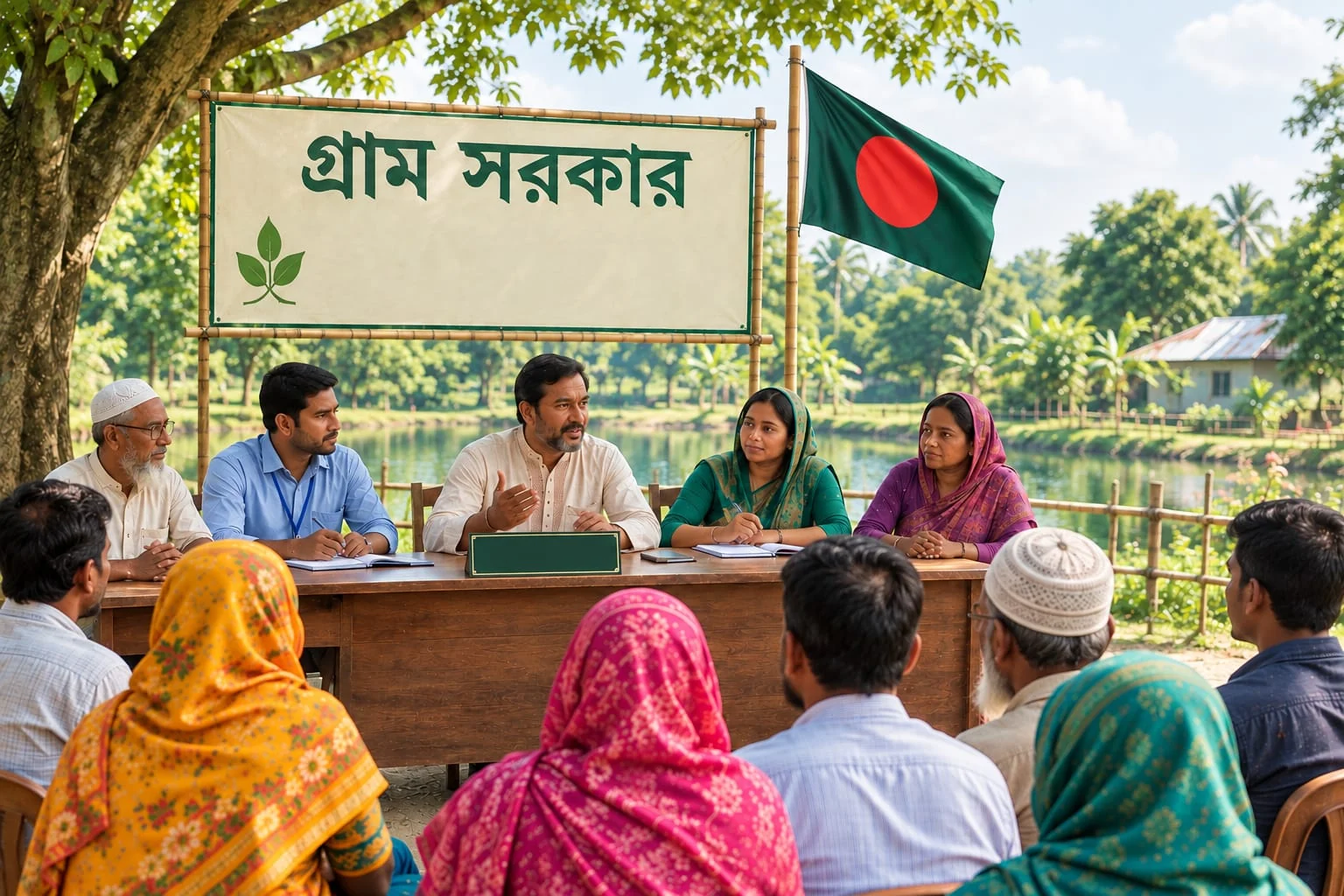
The government is preparing to revive the 'Village Government System' to strengthen grassroots governance, improve transparency in public services, and increase people's participation in local development, with a proposed new law now open for public feedback.
The Local Government Division has formulated the draft Village Government Act 2026 and invited citizens to submit their opinions by November 17 through the email address mentioned in a notice published on its website.
After reviewing public feedback, the draft will be finalised and sent to the Cabinet Division for further consideration.
Officials at the Local Government Division told BSS that the proposal to reinstate the system was raised at a Cabinet meeting on October 5 with Prime Minister Tarique Rahman in the chair. The draft was prepared by revising the Village Government Act 2003, which was repealed in 2009.
If enacted, the law would restore the system after nearly 17 years.
Under the proposed law, one village government would be formed in each ward of every union parishad. Each body would comprise 17 members: a chief, an adviser, and 15 other members. The elected union parishad member representing the ward would serve as the chief, while the reserved-seat member would act as adviser.
The remaining 15 members would be selected through a 'yes-or-no' voting process involving registered voters of the respective ward. At least 10 percent of registered voters would need to participate. Each village government would have a five-year term.
With more than 4,500 union parishads and around 41,000 wards nationwide, the system could involve about 700,000 local leaders, the officials said.
Village governments would assist in preparing development plans, improving local infrastructure, resolving disputes, and reviewing the progress and financial aspects of ongoing projects.
Their responsibilities would also cover preventing violence against women and children, drug abuse, and gambling, and supporting education, family planning, nutrition, immunisation, primary healthcare, safe drinking water, and sanitation.
Other areas would include agriculture, fisheries, livestock, cooperatives, cottage industries, environmental protection, and social safety-net programmes.
The draft also proposes assistance in distributing and collecting information related to Family Cards, Farmer Cards, cards for religious institution leaders, Health Cards, and Sports Cards.
Village governments would support Vulnerable Group Feeding (VGF) and Vulnerable Group Development (VGD) programmes, community cleanliness initiatives, and efforts to encourage household solar power generation and use.
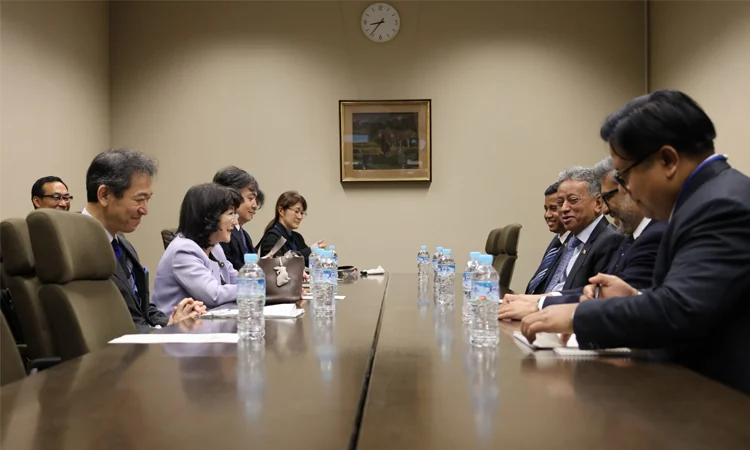
 Read next PM’s Japan Visit Strengthens Development, Investment Partnership: Humaiun
Each village government would meet at least once every two months and hold a general meeting at least once every six months, with at least 10 percent of ward voters attending. Committees and subcommittees could be formed to oversee specific responsibilities.
A separate fund would be maintained for each body, receiving money from union parishads and other sources.
Upazila parishad officials, designated supervising authorities, and union parishad chairmen would be able to inspect its activities. A deputy commissioner (DC) can dissolve a village government following an investigation, but only after giving it an opportunity to explain its position.
AKM Abdul Awal Majumdar, a former secretary and public administration expert involved in good-governance advocacy, told BSS that the initiative could create a direct channel for political representatives and citizens to participate in local affairs.
However, he cautioned that its success would depend on the integrity and competence of those appointed or elected to responsibility.
Unfair decisions made in exchange of money could erode public confidence and damage the government's reputation, he warned.
If operated according to the law, the system could help address people's longstanding disillusionment with politics, he added.
The village government system was first introduced during the regime of BNP founder Ziaur Rahman through the Village Government Act 1980, with the aim of involving rural communities in development and promoting local self-reliance. It was abolished in 1982 during the government of Hussain Muhammad Ershad.
The system was revived through the Village Government Act 2003 under the BNP-led government. However, the Bangladesh Legal Aid and Services Trust challenged a provision allowing members to be nominated rather than elected.
On August 2, 2005, the High Court declared the law unconstitutional and ineffective, raising concerns about democratic representation and the potential for excessive bureaucratic influence. The government's appeal was subsequently rejected.
A repeal ordinance was issued in 2008, and Parliament passed the Village Government (Repeal) Bill on April 6, 2009, formally abolishing the law.
The officials said the current draft is not final and must pass through several stages before becoming law. The bill must be passed in Parliament.
— Daily Best News Desk • Fearless in the search for truth
Reported by Staff Reporter • Edited by the Daily Best News desk. Send corrections to [email protected].