Bobby Hajjaj, State Minister for Primary and Mass Education, has stated that curriculum, teachers, monitoring, infrastructure, and technology—these five areas—must be prioritized and tackled in an integrated manner to achieve quality improvement and desired reforms in primary education. He emphasized that every sector of primary education is closely interconnected, and success cannot be achieved by improving one area while ignoring others. Therefore, integrated reform activities must proceed based on ground-level realities and stakeholder feedback.
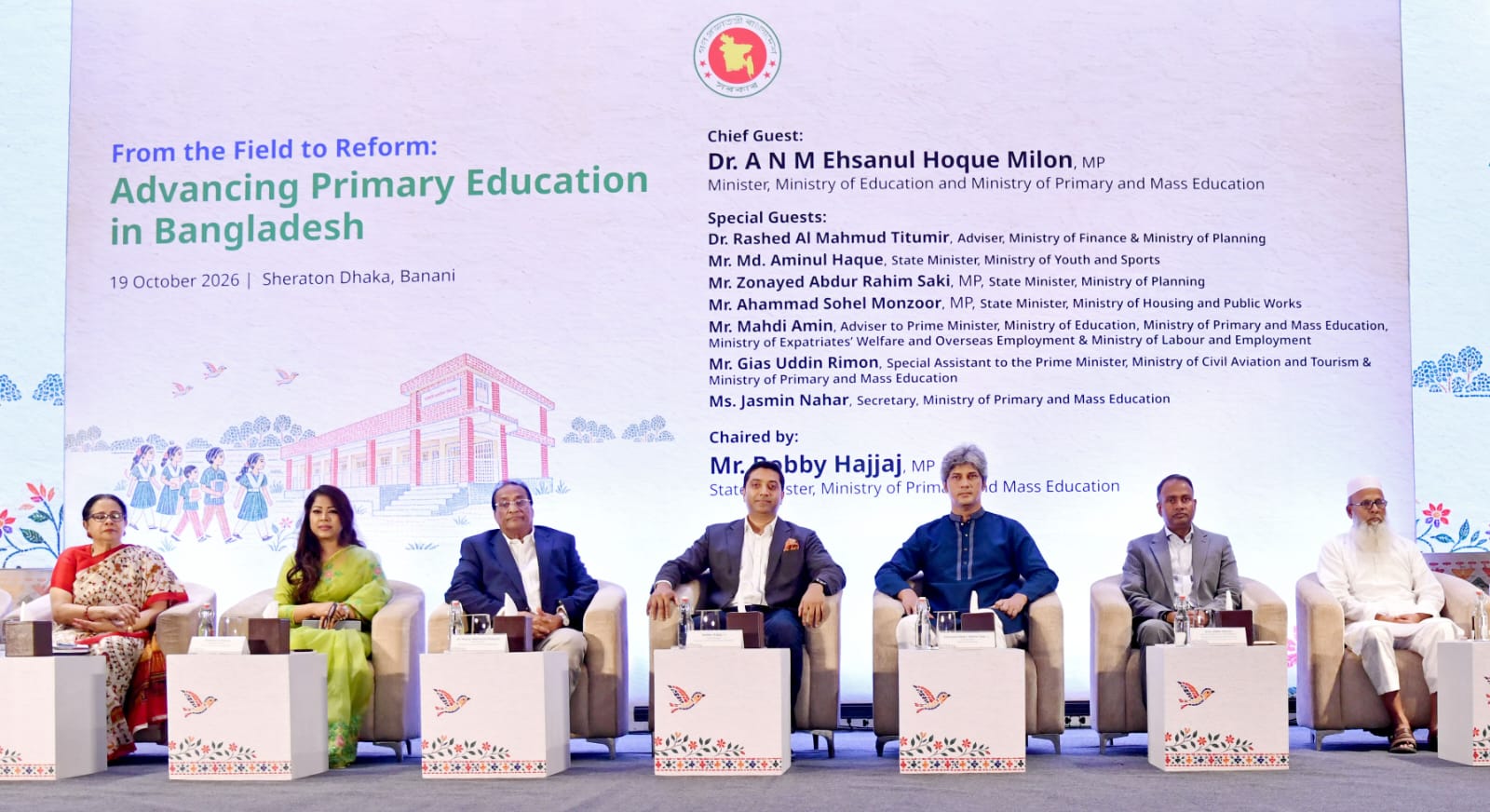
He made these remarks today while presiding over a national dialogue and experience-sharing workshop titled 'From the Field to Reform: Advancing Primary Education in Bangladesh', jointly organized by the Ministry of Primary and Mass Education, the Directorate of Primary Education, and UNICEF at the Hotel Sheraton in the capital.
The State Minister noted that Prime Minister Tarique Rahman has outlined clear future goals and directives for primary education, which the government is actively implementing. In line with the Prime Minister's directives, priority is being given to ensuring educational access for every child, improving education quality, fostering moral values, and building skills suitable for future careers.
Sharing field-level insights, Bobby Hajjaj mentioned that over the past few months, more than 60 hours of discussions were conducted with officials directly involved in primary education, monitoring officers, and school headmasters. Opinions and experiences of over 3,000 stakeholders were reviewed, including direct consultations with more than 1,700 monitoring officers and feedback from over 1,500 headmasters. These discussions provided realistic insights into existing challenges, priorities, and potential solutions in primary education.
He further added that a learning-outcome-based and child-friendly education system is being developed aiming for a new curriculum rollout in 2028. Emphasis will be placed on enhancing skills in Bangla, Mathematics, and English, play-based learning, digital content, and practical learning activities. He also stressed the importance of reducing disparities in school learning hours and establishing necessary standard guidelines for both public and private primary educational institutions.
State Minister Bobby Hajjaj highlighted that a comprehensive teacher policy is being drafted to integrate recruitment, pre-service training, posting, professional development, and performance evaluation to ensure quality primary education. He emphasized not taking classes without proper training, boosting subject-wise expertise, and ensuring continuous professional development for teachers. He also underscored the need to keep teacher and school evaluations separate and to make upazila-level teacher training centers more effective.
Regarding the monitoring system, the State Minister stated that school supervision needs to become more effective by addressing field-level manpower shortages and reducing excessive administrative burdens. Initiatives have been taken to improve the 11-step school inspection system and digital data management. The primary goal of monitoring will not merely be report generation, but ensuring teacher attendance, regular classroom instruction, and actual learning outcomes for students.
On infrastructure, Bobby Hajjaj stated that primary school infrastructure should not be limited to buildings alone; classrooms, furniture, sanitation, and safe water facilities must be child-friendly. Besides creating a safe and child-friendly learning environment, he stressed constructing suitable infrastructure considering geographical realities such as river-erosion-prone and hilly regions.
Regarding technology, the State Minister called for integrating digital content, information management, and technology-driven monitoring to ease teachers' workloads and enhance student learning. He noted that recommendations from the national dialogue will be presented to relevant ministries, directorates, and development partners, emphasizing integrated efforts across curriculum, teachers, monitoring, infrastructure, and technology to nurture genuine learning, skills, and moral values in every child.
Speaking as the chief guest, State Minister for Planning Md. Zonayed Abdur Rahim Saki stated that alongside infrastructure development to improve education quality and reduce dropout rates, priority must be given to teachers' dignity, salaries, allowances, and professional skill development. He informed that the government is working toward allocating 5 percent of GDP to the education sector gradually, with a 2 percent allocation in the first fiscal year alone. He stressed ensuring proper training for teachers, filling teacher shortages, and providing a dignified working environment, while emphasizing depth and quality of learning over volume.
— Daily Best News Desk • Fearless in the search for truth
Reported by Jahangir Alam Manik, Dhaka • Edited by the Daily Best News desk. Send corrections to [email protected].