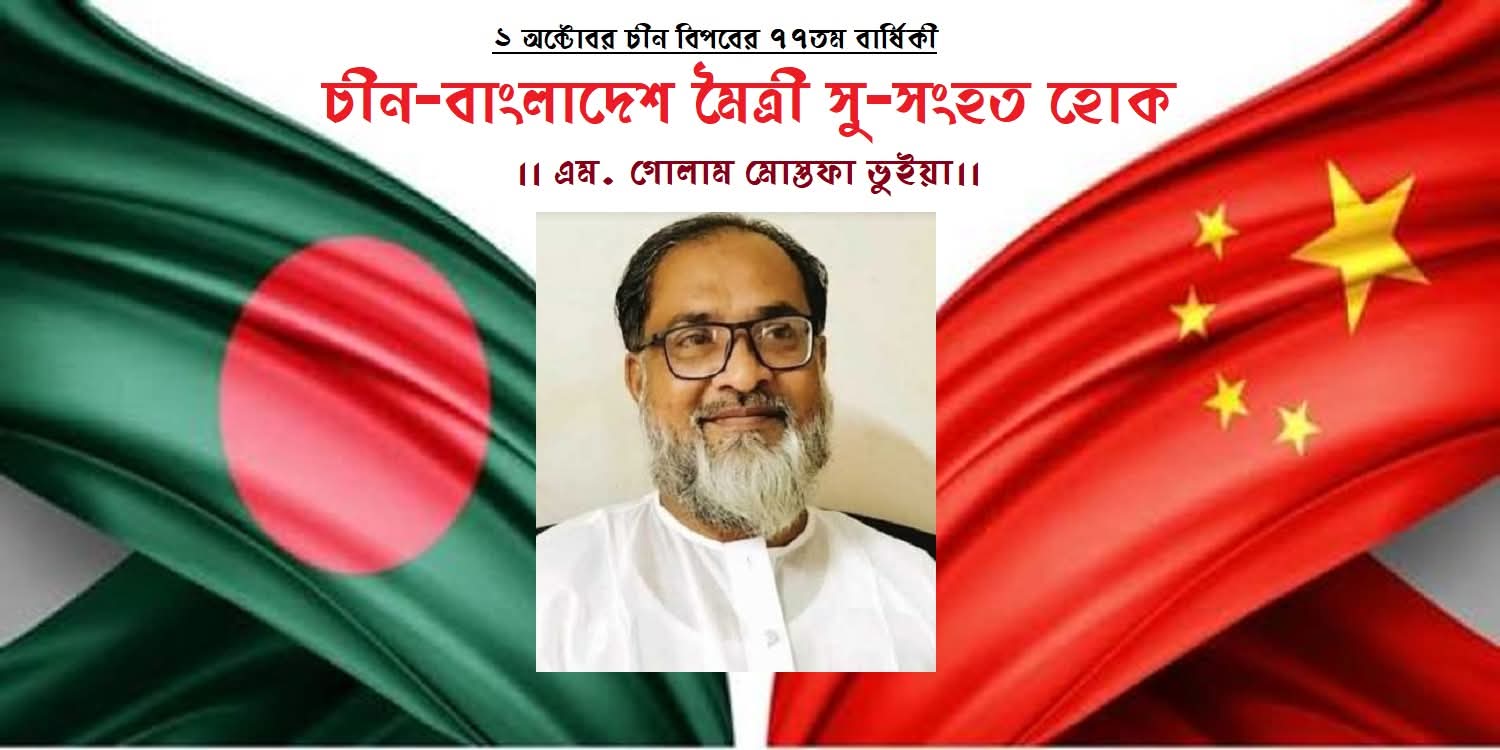
October 1, 2026, marks the 77th anniversary of the Chinese Revolution and the National Day of China. On this day in 1949, following a successful revolution under the great leader of China, Mao Zedong, the People's Republic of China officially began its journey. On this auspicious occasion, the people of Bangladesh extend their warmest greetings and congratulations to the people of China. Regardless of which political party holds state power in a sovereign Bangladesh, everyone wishes to maintain a relationship of sincere friendship and cooperation with the world's most populous nation, and everyone remains eager to strengthen economic ties. For obvious reasons, this prosperous nation in the Asia-Pacific region has now become Bangladesh's primary partner in trade and development. The China-Bangladesh relationship is a bilateral bond between two nations. Historians note that the relationship between Bangladesh and China is ancient, spanning nearly three thousand years. Contacts between Bengali civilization and Chinese civilization have existed for a thousand years even before the birth of Christ. Since ancient times, human connectivity between China and Bengal was established via the Brahmaputra River. Although modern diplomatic relations between China and Bangladesh were established in 1975, China is currently one of the most important partners in Bangladesh's development, and Bangladesh is China's second-largest trading partner. Historians state that the ancient route connecting Bangladesh to China is famously recorded in history as the Silk Road. There was a Western Silk Road, which originated from the capital city of Chang'an (modern-day Xi'an). Passing through Xinjiang and Afghanistan, that route reached India and eventually Bangladesh (Mongchiala). For centuries, this Mongchiala served as the bridge of relations between China and South Asia. There was also an Eastern Silk Road, originating from Kunming in southern China, which established a connection with Bangladesh through Myanmar. Through these two routes, trade expanded, and cultural exchanges grew. Since ancient times, as both China and Bangladesh are coastal nations, their exchanges via maritime routes were magnificent. Nearly 600 years ago, Emperor Yongle was the powerful monarch of China's Ming Dynasty. The greatest navigator of that era, Admiral Zheng He, served as the Emperor's peace ambassador, voyaging across the Indian Ocean and the Pacific Ocean. He established the maritime Chinese Silk Road. From 1405 to 1433 AD, Admiral Zheng He led seven inter-oceanic expeditions with a massive fleet of over a hundred ships, visiting 30 countries and regions across Asia and Africa. Admiral Zheng He's fleet visited the port of Chittagong twice. The ruler of Bengal, Sultan Ghiyasuddin Azam Shah, warmly welcomed the Chinese admiral in his capital, Sonargaon. Later, the Sultan sent various precious gifts, including a long-necked giraffe, to the court of the Ming Emperor. According to Chinese tradition, the giraffe is regarded as a symbol of good fortune. Although China has been a formidable nation in naval and military power since ancient times, throughout its entire history, China never established colonies in any other country, nor did it conquer any nation. Instead, it has consistently shown profound respect for the independence and sovereignty of all countries. Immediately following the Chinese Revolution in 1949, relations between Bangladesh and China took on a new form. This relationship was not bound by formal state diplomatic rules; it was ideological and spiritual. This bond grew directly from the leftist movement in Bangladesh. During the 1950s and 1960s, Chinese Premier Zhou Enlai visited Bangladesh (then East Pakistan) on multiple occasions. Even before independence, the Communist Party of China maintained friendly relations with nationalist leaders of Bengal—particularly with the visionary of an independent Bangladesh, the voice of the oppressed and exploited peoples of Afro-Asia and Latin America, and the founder of National Awami Party (NAP), Mawlana Abdul Hamid Khan Bhashani. Later, NAP Chairman and national leader Mashiur Rahman Jadu Mia visited China in 1962 as the Deputy Leader of the Opposition in the Pakistan National Assembly, taking initiatives to advance friendly relations with China. When Mawlana Bhashani fell ill at that time, Jadu Mia led the delegation. He visited China during the period when China embarked on its new journey under Mao Zedong's leadership. During his visit, he sought to understand many aspects of New China that people usually tended to avoid. Mawlana Bhashani's visit to China was profoundly significant. Observing China's past history, current politics, culture, and the daily life of ordinary people with deep attention, and acquiring vast experience, Mawlana Bhashani remarked upon returning home: "In today's conflict-ridden world, China is a great wonder. China is now the leader of the liberation struggle of the looted populations of Asia, Africa, and Latin America. China is the pilgrimage of liberation for the newly awakened peoples of these three continents; I went on that pilgrimage. That pilgrimage was not in vain. In the radiant light of a new consciousness, I have learned to view my eighty years of chaotic life anew, and therefore I have no regrets; those who are still hurling slanders will one day realize their mistake." He further stated: "China is the truest and most dependable friend of the world's deprived peoples. Therefore, China is the greatest enemy of imperialism. Conspiracies are afoot everywhere to eradicate China and the struggle of the Chinese people. Our country was also a part of that conspiracy. It is the sacred duty of the 190 crore people of Asia, Africa, and Latin America to resist anti-China conspiracies wherever, however, and to whatever extent possible." He added, "If my travel experiences can even slightly help my compatriots in being inspired by that international resistance struggle, I shall consider myself blessed." Expressing fascination with the progress of New China, the legendary leader affectionately known as 'Red Mawlana', Mawlana Bhashani, remarked: "I have seen China. At my age, it is neither possible nor the time to take new lessons. Yet, by seeing China—a nation of 720 million people built by the hands of Mao Zedong and his comrades—I have had the opportunity to recognize myself and my country in a new light. How much transformation this self-realization can bring to myself is hard to say, and whether I can truly help my country remains an even more challenging question. Just as I found the pursuit of a novel life effort in Great China, many of my friends and allies found sources of doubt in my visit. Just as the value of what I gained by touring China cannot be easily measured, the ripples of anxiety stirred in the minds of many of my friends will not easily fade away. Of course, one thing is certain: had I not visited China, it might not have been impossible to find reasons for my friends to be angry with me. The diverse and multi-colored pictures painted on the canvas of my 77 years of experience do not match the experiences I gained in China. Yet, the reactions I witnessed among my friends were all too familiar to me." The rhythm of China-Bangladesh relations experienced a setback centered around Bangladesh's War of Independence. During the 1971 Liberation War of Bangladesh, amidst complex geopolitical rivalries in South Asia, China sided with Pakistan and opposed Bangladesh. For various reasons, China had a hostile relationship with the Soviet Union, and tensions with India following the 1962 Sino-Indian War had turned acute. Under these circumstances, while the Soviet Union and India supported Bangladesh's liberation struggle, China took the side of Pakistan as the sole nation in South Asia to do so. Diplomatic relations between China and Bangladesh were established in January 1976. The foundation established at the end of 1975 and the beginning of 1976 relied primarily on security issues. From that perspective, the relationship remained circumscribed within a military-political circle. Consequently, the initial thread of post-independence relations with the country began through arms supply. Given that China sided with Pakistan for 'strategic' reasons during our War of Independence, it is not entirely unnatural for some in our generation to harbor lingering doubts due to ideological sentiments. However, we also understand that China's stance at that time transcended regional chemistry and was a product of international politics. During his tenure as head of state, Martyred President Ziaur Rahman pursued an eastward diplomacy. During this period, China was equally attentive to improving relations with Bangladesh. The political philosophies of the two countries are distinct, and there are vast differences in language and culture. Yet, our relationship stands as a world model; it has never faltered. Ziaur Rahman, Hussain Muhammad Ershad, Begum Khaleda Zia, and Sheikh Hasina have all visited China, continuously making maximum efforts to enhance bilateral ties. Most recently, the visit of Prime Minister Tarique Rahman to China has elevated China-Bangladesh relations to an even more significant level. Tarique Rahman's visit has lifted the bilateral relations between Bangladesh and China to a new strategic height and historical milestone. Held in June 2026, this visit led both nations to enter a new era of building a "China-Bangladesh Community with a Shared Future" by further strengthening their ties. Current China-Bangladesh relations stand at their highest historical peak. The most crucial achievement of this visit is advancing the China-Bangladesh 'Comprehensive Strategic Cooperative Partnership' to foster a community of shared future in the new era. The ruling BNP government, the former interim government, Bangladesh NAP, and almost all political parties in Bangladesh desire sound relations with China, and everyone remains dedicated to this goal. Our people also wish for this bond of friendship to remain unbreakable forever. We receive various forms of cooperation from China. From trade relations and infrastructure development to sports, China cooperates across numerous fields. There is special cooperation in the defense sector. The armed forces of Bangladesh contribute to UN peacekeeping missions across the globe, earning renown as a skilled and proficient force. Behind the status and dignity of our country's armed forces as a modern, professional entity, China's role will certainly be remembered. After gaining independence, China first carried out an agricultural revolution, ensuring that no one died of famine.
Following its industrial revolution, China has now transformed its character. Therefore, showing blind devotion toward them without reason is pointless, but we must adopt their best attributes. The Chinese people were once divided across various classes and professions, but Mao Zedong successfully united them around nationalism. This is precisely why modern China was born. Mao Zedong's statecraft completely transformed China. Under his capable leadership, China rapidly evolved from a feudal society into a modern society in a remarkably short span. Throughout his life, Mao Zedong's political philosophy and revolutionary theories made him both a symbol of struggle for the world's oppressed peoples and a target of intense criticism from various quarters. Mao Zedong was not merely a revolutionary leader; he was a leader of leaders. It is because of him that China is able to stand on its own feet today, though it required immense struggles. The history of China is unimaginable without Mao Zedong.
China is our friendly nation, a country close to our hearts. October 1, 2026, is the 77th anniversary of the Chinese Revolution—the National Day of the People's Republic of China, Republic Foundation Day. On this very day, China cast off the yoke of humiliation and disgrace of millennia of semi-colonialism and semi-feudalism from its shoulders, shattered its chains of bondage to pieces, and raised its hands high, shouting in the exultation of creation. Today is the day of great emancipation and great victory for the Chinese people.
Under the leadership of Chairman Mao Zedong, the revolutionary Chinese armed forces liberated all of China, and on October 1, 1949, Mao Zedong proclaimed the establishment of the People's Republic of China from the rostrum of Tiananmen Square before a massive gathering of 300,000 people. He declared in resounding tones: "The whole world is a friend to China." China stands firmly on its own feet. It has shaken off millennia of subjugated shame, humiliation, and disgrace. In the future, China will never tolerate any insult or indignity ever again. Chairman Mao kept his word. The CPC kept its word. China kept its word. Today, a volatile world looks toward peace-loving, socialist, progressive People's China. Expectations from China are high worldwide. China will play a monumental role in global peace, order, stability, and the development and progress of humankind. As Mao Zedong stated: "The entire world is a friend to China." We believe that in the days ahead, as China ascends to new heights of glory through peace, progress, and dignity, it will make profound contributions toward making all neighboring countries, the entire Asian region, and the world at large peaceful, harmonious, prosperous, benevolent, and aesthetic. On this auspicious day of the 77th founding anniversary of Great China, our heartfelt congratulations. Long live the People's Republic of China. Long live the Chinese people. Long live China-Bangladesh friendship. May China-Bangladesh friendship grow ever stronger.
M. Golam Mustafa Bhuiyan Politician, Political Analyst, and Columnist E-mail: [email protected]
— Daily Best News Desk • Fearless in the search for truth
Reported by M. Golam Mustafa Bhuiyan • Edited by the Daily Best News desk. Send corrections to [email protected].