The Bangladesh Institute of Planners (BIP) has urged state authorities to integrate urban planning into public health strategies to control escalating health crises, including dengue, measles, waterlogging, air pollution, and urban heat islands.
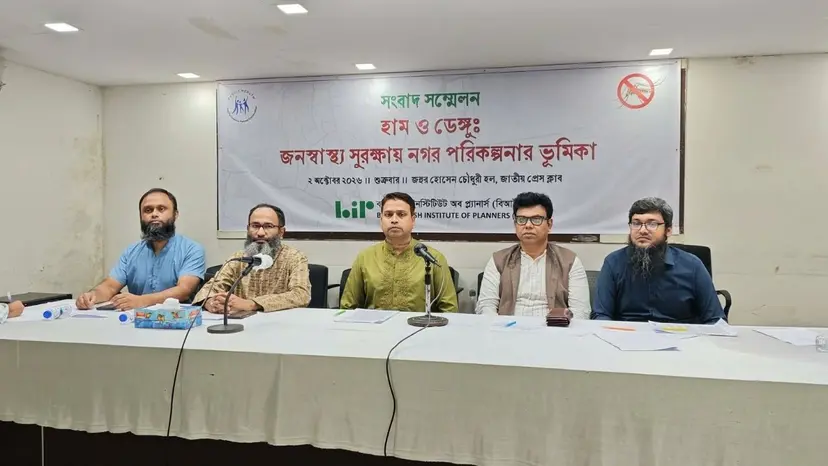
Speaking at a press conference titled "Measles and Dengue: The Role of Urban Planning in Safeguarding Public Health" held at the National Press Club in Dhaka on Friday (October 2, 2026), BIP President Dr. Muhammad Ariful Islam asserted that disease prevention requires structural interventions rather than solely relying on post-outbreak medical treatment. Citing Directorate General of Health Services (DGHS) data, BIP noted that 79,620 dengue hospitalizations and 245 deaths were recorded across the country through September 30, 2026, alongside 21,520 confirmed measles cases and 1,108 related fatalities since mid-March. The planners highlighted that stagnant water in multi-story and under-construction buildings accounts for a significant proportion of Aedes mosquito breeding sites. BIP recommended mandating basement water management in building approvals, implementing GIS-based high-risk mapping, establishing mobile vaccination hubs in high-density informal settlements, and bolstering inter-agency coordination among DGHS, Rajuk, WASA, and city corporations.
— Daily Best News Desk • Fearless in the search for truth
Reported by Staff Reporter • Edited by the Daily Best News desk. Send corrections to [email protected].