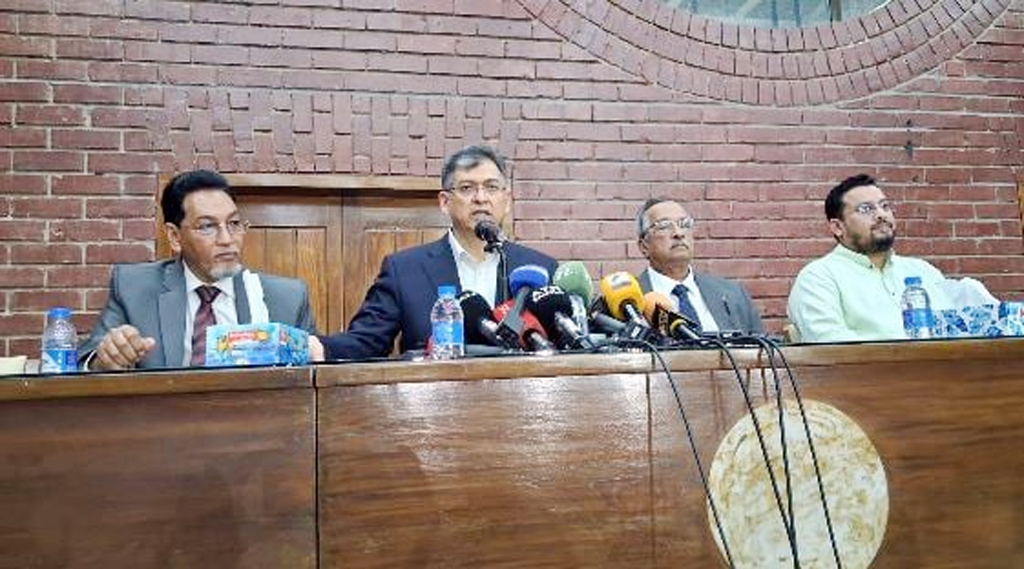
Home Minister and Chairman of the Special Committee on Constitutional Amendment, Salahuddin Ahmed, has stated that following the passage of the constitutional amendment bill in the national parliament, a referendum will be held before the President's assent on matters that carry constitutional obligations. The special committee aims to submit its report to parliament this December, and based on it, the bill could be brought to parliament through the Ministry of Law during the first session in January.
The minister made these remarks today (Sunday) during a views-exchange meeting between the special committee on constitutional amendment and editors and senior journalists from various media outlets, held at the national parliament. During the meeting, media personalities strongly advised taking the main opposition along to amend the constitution on the basis of a consensus.
Presided over by committee chairman and Home Minister Salahuddin Ahmed, the meeting—held from 2:30 PM to 5:20 PM—was attended by Chief Whip Nurul Islam Moni, Parliamentary Standing Committee on Ministry of Home Affairs Chairman Zainul Abedin, State Minister for Planning Zunaid Abdur Rahim Saki, State Minister for Land Mir Mohammad Helal Uddin, State Minister for Social Welfare Farjana Sharmin, along with Shakila Farzana and Md. Mahmudul Haque Rubel. Twenty-six journalist representatives attended, including Daily Star Editor Mahfuz Anam, Prothom Alo Editor Matiur Rahman, New Age Editor Nurul Kabir, Somokal Editor Shahed Md. Ali, Banik Barta Editor Dewan Hanif Mahmud, Desh Rupantor Editor Mustafiz Shafi, Daily Odhikar Editor Shafiqul Islam, Principal Information Officer Syed Abdal Ahmad, former Media Commission head Kamal Hossain, BPJA President Harun Jamil, and General Secretary Shawkat Ali Khan Litho.
Briefing after the meeting, the Home Minister said, "Many editors have suggested that we should re-invite opposition members to join this committee so that proposals can be formulated on the basis of consensus. We completely agree with this. We are inviting them during the session and even now. We will welcome them whenever they join. Had they participated, it would have been easier to incorporate many of the proposals put forward by their party."
The Home Minister further stated that the July National Charter will be implemented completely, just as it was signed. Alongside this, the election manifesto and other necessary proposals that emerge through consensus will also be considered. They will be implemented either through a constitutional amendment or the enactment of new laws.
Responding to questions regarding the legal basis and obligation of a referendum, the special committee chairman explained that the provision for a referendum in Article 142 of the constitution had been removed through the Fifteenth Amendment. However, following the July uprising, the High Court's order reinstated Article 148, bringing back the referendum provision into the constitution. He clarified that a referendum will not be required for the entire constitutional amendment; rather, if parliament makes changes in special areas such as the preamble and Articles 48 and 56, it is a constitutional obligation to put it to a referendum before the President signs it. Additionally, if BNP's proposed extra articles—including the caretaker government system—are to be changed in the future, a referendum will also be necessary.
When asked whether the July Charter or BNP's manifesto would hold more weight, the Home Minister stated, "Here, the first priority is the July National Charter. However, our election manifesto, which earned the people's mandate, will also be accommodated. For example, incorporating 'trust and faith in Almighty Allah' into the principles of state policy was our commitment, and the opposition party also agreed to this at the National Consensus Commission."
Editors and media representatives present at the views-exchange meeting raised several important proposals and opinions:
* Journalists requested stronger efforts to include five members of the main opposition in the committee so that everyone's opinions are reflected. * They suggested exploring alternative methods to ensure that the President cannot under any circumstances become the head of a caretaker government and to keep the judiciary completely out of this process. * Urgency was expressed to ensure a check and balance of power between the President and the Prime Minister by reducing the Prime Minister's absolute power, separating the posts of Prime Minister and party chief, decentralizing the Supreme Court, and quickly implementing the constitutional post of "Ombudsman."
* Speakers demanded proportional representation in the upper house if a bicameral parliament is established, though some questioned whether this would cause financial waste. * Proposals were also made to vest the appointment of heads of constitutional bodies, including the Anti-Corruption Commission (ACC), under the authority of the President. * An editor of an English daily proposed the formation of a "Constitutional Council" alongside elected members of parliament and voiced support for replacing the colonial mindset of the word "People's Republic" with simply "Republic."
— Daily Best News Desk • Fearless in the search for truth
Reported by Staff Reporter, Dhaka • Edited by the Daily Best News desk. Send corrections to [email protected].