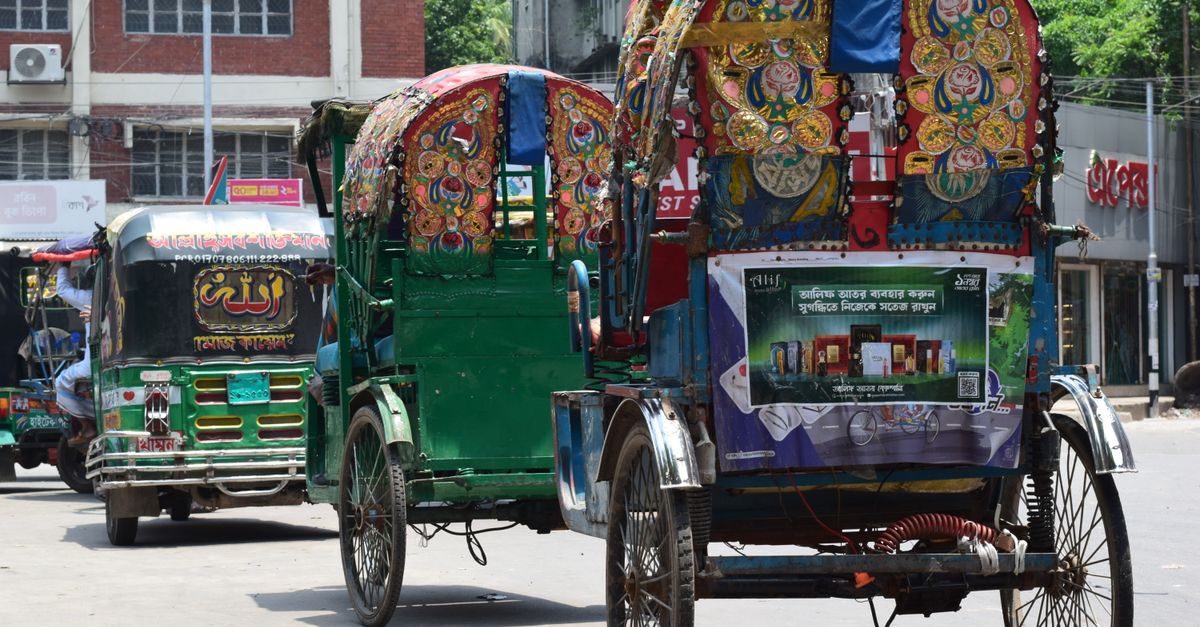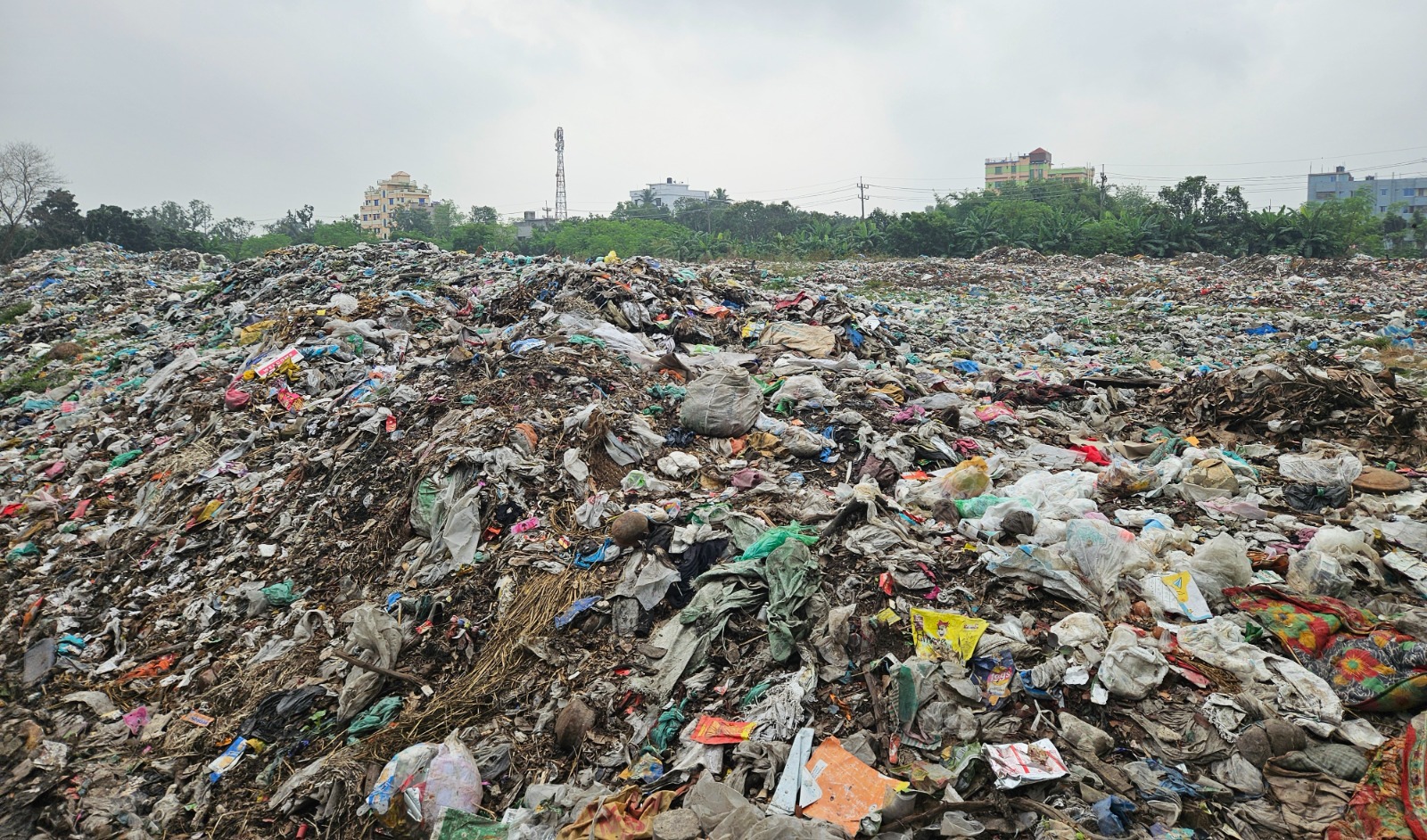
Residents of Chapainawabganj municipality are facing severe health risks and daily suffering as heaps of unmanaged urban waste continue to be dumped along roadside areas in densely populated neighborhoods.
Ekramul Haq, a local teacher residing in the Nayagola Moar area, reported that municipal waste brought by trucks is dumped at the Nayagola dumping station in the middle of a populated area. Strong stenches spread across the surrounding neighborhood whenever the wind blows, making daily living extremely difficult for local residents.
Similarly, Sabera Khatun, an employee commuting daily from the Police Lines area through Nayagola, shared that the foul odor penetrates homes and becomes unbearable during rains, heightening long-term public health concerns.
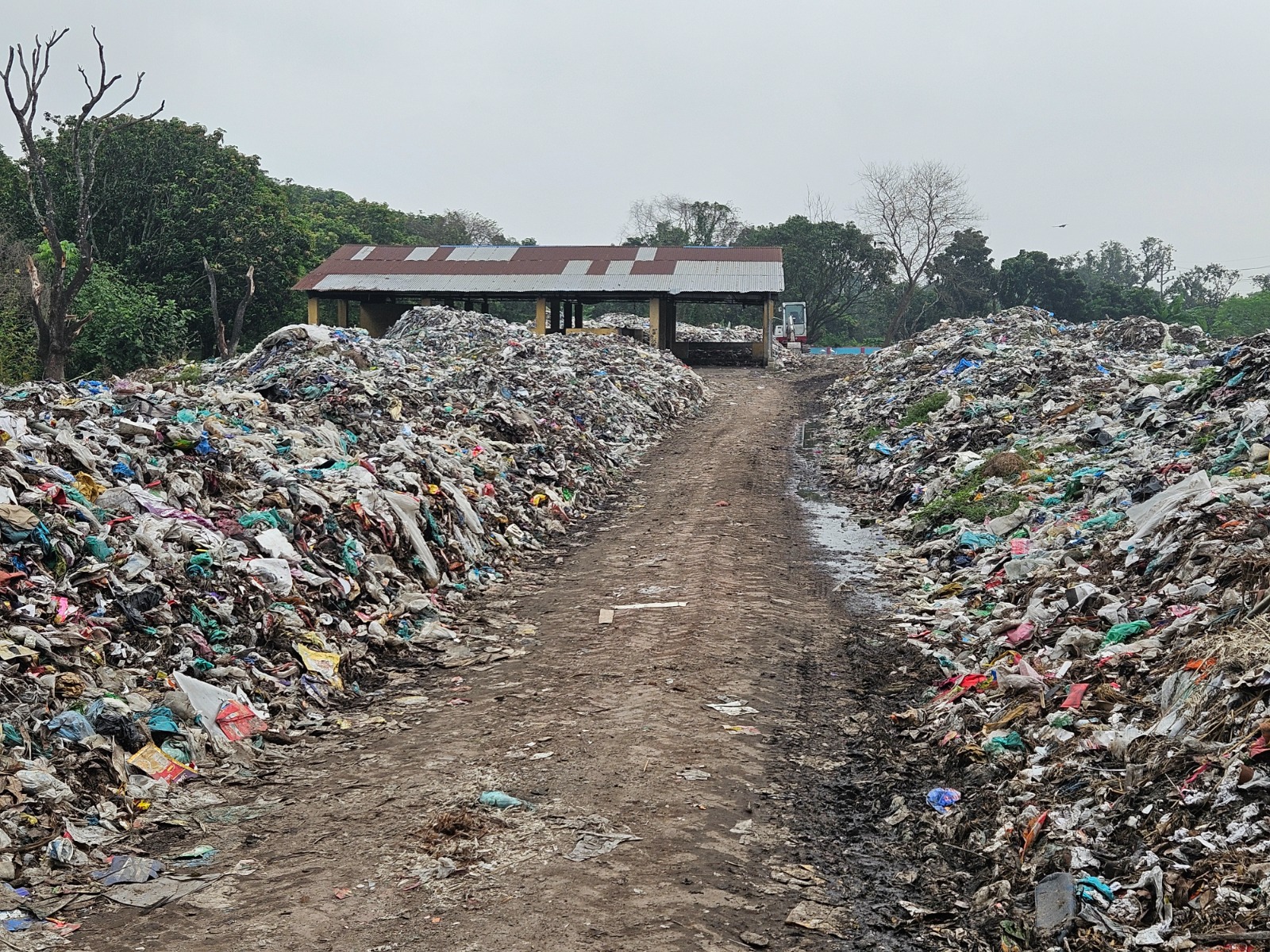
Currently, all household waste generated across Chapainawabganj municipality is deposited at roadside locations in Nayagola Moar—situated directly opposite the Police Lines—as well as at another dumping site in Darijapur. Both the Nayagola and Darijapur landfield sites have essentially turned into massive garbage heaps.
Locals pointed out that despite being a century-old municipality, Chapainawabganj lacks a planned waste management system. Due to flawed initial planning, the solitary sanitary landfield constructed at a cost of Tk 13 crore has failed to yield effective results, forcing the municipality to rely on traditional dumping methods. With both landfill sites reaching their maximum holding capacities, the absence of modern waste management poses a critical threat to public health.
Municipal sources revealed that Chapainawabganj generates 60 to 70 tons of waste daily, of which approximately 50 tons are collected without segregation and transported directly to secondary transfer stations or local containers before being dumped at the landfills. Traditional disposal methods leave environmental protection largely ignored.
 Read nextFather Accused of Attempting to Misappropriate Sons' Property in Charfassion
A physical inspection at the Nayagola dumping station revealed waste piled nearly 10 feet high across 3.46 acres of land. Meanwhile, the 4-acre Darijapur landfield, established in 2020, lacks processing facilities despite having basic infrastructure.
Consequently, the sheer volume of accumulating waste has far exceeded the capacity of both sites.
Addressing the situation, Dr. Md. Mahbub Hasan, Resident Medical Officer (RMO) of the 250-bed Chapainawabganj District Hospital, stated that dumping garbage in open spaces carries severe health hazards. Microscopic dust particles and pathogens carried by the wind are inhaled by residents, necessitating immediate authority intervention for enclosed and controlled dumping.
Md. Moniruzzaman Monir, Member Secretary of the local Citizen Committee, emphasized that rapid urbanization and population growth have compounded the waste challenge, making scientific waste management an urgent priority.
Providing administrative updates, Chapainawabganj Municipality Urban Planner Imran Hossain stated that a new comprehensive plan funded by the Urban Infrastructure and Governance Improvement Project (IUGIP) and the Asian Development Bank (ADB) has been formulated to modernize the existing sanitary landfield.
Under this initiative, representatives and project officers from ADB and IUGIP are scheduled to inspect the municipality on November 5 to introduce waste segregation, composting, and recycling facilities.
Chapainawabganj Municipality Executive Officer Mamun Or Rashid confirmed that while the municipality regularly collects nearly 50 tons out of the 60 to 70 tons of daily waste, the absence of a permanent and modern landfield facility has hindered comprehensive waste management. He expressed optimism that the new project initiatives will deliver a sustainable solution.
— Daily Best News Desk • Fearless in the search for truth
Reported by Md. Tarek Rahman, Chapainawabganj Correspondent • Edited by the Daily Best News desk. Send corrections to [email protected].