Shortages and Escalating Prices Hit Essential Commodities Across Dhaka Markets

Best News Desk
১২-৯-২০২৬ দুপুর ১২:৩০
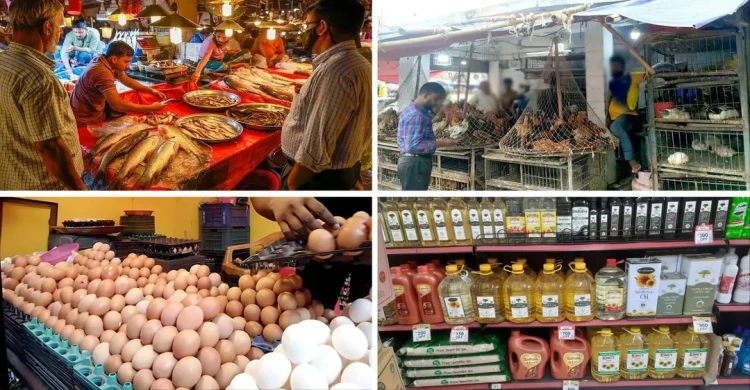
Shortages and Escalating Prices Hit Essential Commodities Across Dhaka Markets
Essential commodity markets across Dhaka continue to experience severe price volatility and persistent supply shortages, with rising prices of edible oil, poultry, eggs, fish, and meat causing widespread distress among low- and middle-income consumers.
A market survey conducted on Saturday (September 12) across key capital hubs—including Mugda, Maniknagar, Kamalapur, Khilgaon, and Basabo—revealed that farm-raised chicken eggs are retailing at Tk 150 per dozen. Prices have failed to normalize since escalating in early August from previous averages of Tk 130 to Tk 140 per dozen.
Similarly, broiler chicken prices have surged to Tk 190–200 per kilogram, up from Tk 170–180 per kg recorded in recent weeks. Sonali chicken saw a sharp week-on-week increase of Tk 30 per kg, selling at Tk 340 to Tk 360 per kg compared to earlier rates of Tk 300 to Tk 330 per kg.
Traders cited severe production disruptions as the primary driver behind the supply-side crunch. Recent flooding, prolonged heatwaves, and persistent power outages have caused high mortality rates across poultry farms nationwide, deterring many farmers from restocking their sheds and subsequently reducing both meat and egg outputs.
Confirming the sector's strain, M. Safir Rahman, General Secretary of the Bangladesh Poultry Industries Association (BPIA), noted that recent catastrophic floods severely hit layer farming operations. The loss of livestock and farm infrastructure caused an immediate supply deficit in national distribution chains, triggering price hikes.
Fish prices remain similarly elevated, with farmed pangas selling between Tk 250 and Tk 300 per kg, and tilapia between Tk 250 and Tk 280 per kg—marking a Tk 20 to Tk 30 per kg increase compared to the previous week. Large rui weighing 2.5 to 3 kg is retailing at Tk 400 per kg, while katla is priced at Tk 420 per kg. Red meat offers no reprieve, with beef commanding Tk 800 to Tk 850 per kg and mutton retailing between Tk 1,200 and Tk 1,300 per kg.
Compounding the crisis is a acute shortage of bottled edible oil. Following a Tk 5-per-litre price adjustment introduced by refiners on September 2—which set one-litre bottled soybean oil at Tk 204—retail supplies have largely dried up. Grocery retailers report that distributors are failing to deliver orders, leaving shelves bare of bottled oil and forcing consumers to either buy loose unrefined oil or return empty-handed.
With essential food staples escalating simultaneously, low-income families are increasingly forced to cut daily consumption volumes, further compounding household financial strains.
Best News Desk
১২-৯-২০২৬ দুপুর ১২:৩০
Essential commodity markets across Dhaka continue to experience severe price volatility and persistent supply shortages, with rising prices of edible oil, poultry, eggs, fish, and meat causing widespread distress among low- and middle-income consumers.
A market survey conducted on Saturday (September 12) across key capital hubs—including Mugda, Maniknagar, Kamalapur, Khilgaon, and Basabo—revealed that farm-raised chicken eggs are retailing at Tk 150 per dozen. Prices have failed to normalize since escalating in early August from previous averages of Tk 130 to Tk 140 per dozen.
Similarly, broiler chicken prices have surged to Tk 190–200 per kilogram, up from Tk 170–180 per kg recorded in recent weeks. Sonali chicken saw a sharp week-on-week increase of Tk 30 per kg, selling at Tk 340 to Tk 360 per kg compared to earlier rates of Tk 300 to Tk 330 per kg.
Traders cited severe production disruptions as the primary driver behind the supply-side crunch. Recent flooding, prolonged heatwaves, and persistent power outages have caused high mortality rates across poultry farms nationwide, deterring many farmers from restocking their sheds and subsequently reducing both meat and egg outputs.
Confirming the sector's strain, M. Safir Rahman, General Secretary of the Bangladesh Poultry Industries Association (BPIA), noted that recent catastrophic floods severely hit layer farming operations. The loss of livestock and farm infrastructure caused an immediate supply deficit in national distribution chains, triggering price hikes.
Fish prices remain similarly elevated, with farmed pangas selling between Tk 250 and Tk 300 per kg, and tilapia between Tk 250 and Tk 280 per kg—marking a Tk 20 to Tk 30 per kg increase compared to the previous week. Large rui weighing 2.5 to 3 kg is retailing at Tk 400 per kg, while katla is priced at Tk 420 per kg. Red meat offers no reprieve, with beef commanding Tk 800 to Tk 850 per kg and mutton retailing between Tk 1,200 and Tk 1,300 per kg.
Compounding the crisis is a acute shortage of bottled edible oil. Following a Tk 5-per-litre price adjustment introduced by refiners on September 2—which set one-litre bottled soybean oil at Tk 204—retail supplies have largely dried up. Grocery retailers report that distributors are failing to deliver orders, leaving shelves bare of bottled oil and forcing consumers to either buy loose unrefined oil or return empty-handed.
With essential food staples escalating simultaneously, low-income families are increasingly forced to cut daily consumption volumes, further compounding household financial strains.