Thousands Form Human Chain in Faridpur Demanding Permanent Solutions to Padma River Erosion

Sheikh Faiz Ahmed, Faridpur
১০-৯-২০২৬ বিকাল ৫:২৭
Thousands Form Human Chain in Faridpur Demanding Permanent Solutions to Padma River Erosion
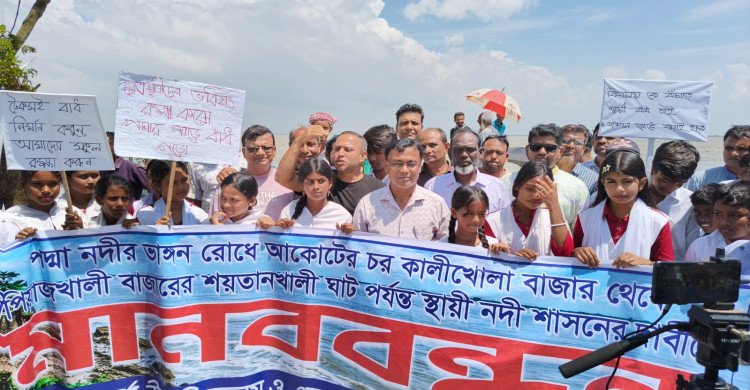
A massive human chain was organized on the banks of the Padma River adjacent to Jonsongh Adarsha High School in Akoterchar Union, Sadarpur Upazila, Faridpur, to intensify demands for permanent river training and erosion prevention. The program took place on Thursday (September 10) at 10:00 AM under the initiative of the high school.
Speaking as the chief guest, Md. Ayub Ali, the headmaster of the organizing institution, presented a grim picture of erosion, stating that it is getting out of control with approximately 200 to 300 meters of arable land, homesteads, and vital structures being swallowed by the river every monsoon. He expressed grave concern that the centuries-old traditional "Piyazkhali Hat," several high schools, government primary schools, and Kalibari Bazar are currently facing severe erosion threats, risking total erasure from the map if left unaddressed.
Organized to voice the long-standing grievances and demands of the locals, speakers at the human chain urged high-level government intervention to save the local community. Rejecting temporary measures like geotextile bag dumping, participants strongly demanded permanent river training and effective erosion control. Thousands of local residents, teachers, students, journalists, and people from all walks of life voluntarily participated along the riverbank to express solidarity with the struggle of the erosion-affected population.
Sheikh Faiz Ahmed, Faridpur
১০-৯-২০২৬ বিকাল ৫:২৭
A massive human chain was organized on the banks of the Padma River adjacent to Jonsongh Adarsha High School in Akoterchar Union, Sadarpur Upazila, Faridpur, to intensify demands for permanent river training and erosion prevention. The program took place on Thursday (September 10) at 10:00 AM under the initiative of the high school.
Speaking as the chief guest, Md. Ayub Ali, the headmaster of the organizing institution, presented a grim picture of erosion, stating that it is getting out of control with approximately 200 to 300 meters of arable land, homesteads, and vital structures being swallowed by the river every monsoon. He expressed grave concern that the centuries-old traditional "Piyazkhali Hat," several high schools, government primary schools, and Kalibari Bazar are currently facing severe erosion threats, risking total erasure from the map if left unaddressed.
Organized to voice the long-standing grievances and demands of the locals, speakers at the human chain urged high-level government intervention to save the local community. Rejecting temporary measures like geotextile bag dumping, participants strongly demanded permanent river training and effective erosion control. Thousands of local residents, teachers, students, journalists, and people from all walks of life voluntarily participated along the riverbank to express solidarity with the struggle of the erosion-affected population.